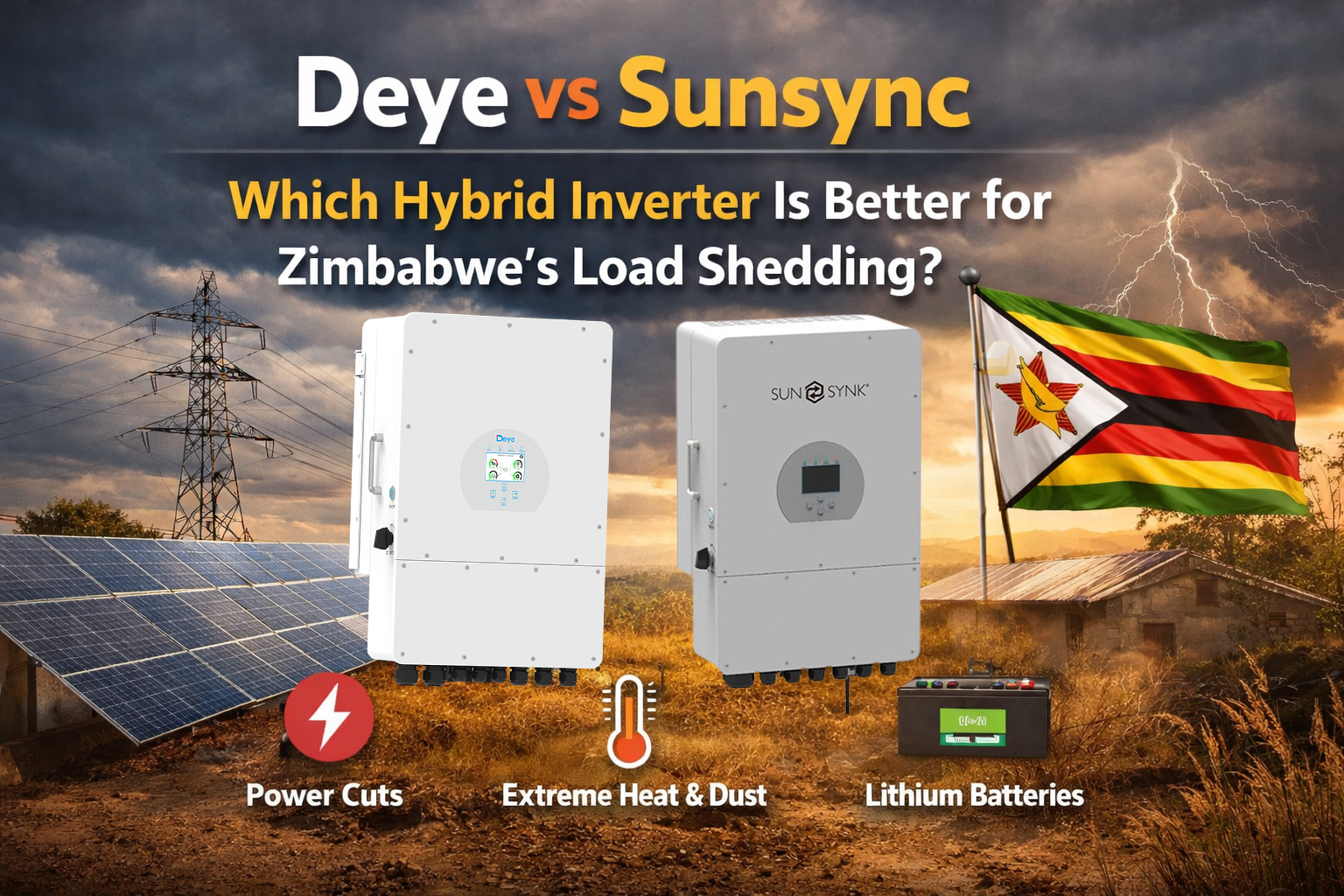
Deye vs Sunsync: Which Hybrid Inverter Is Better for Zimbabwe’s Load Shedding Conditions?
1. Introduction: Why This Comparison Matters in Zimbabwe
If you live in Zimbabwe, you already know the problem.
ZESA power cuts are unpredictable.
Voltage fluctuates.
Power comes back with spikes.
You cannot plan your day around unstable electricity.
That is why hybrid inverters have become essential.
Two names come up again and again:
- Deye
- Sunsync
Both are popular.
Both are hybrid.
Both claim to handle load shedding well.
But which one is actually better for your home or business in Zimbabwe?
In this guide, I will break it down clearly so you can make a confident decision.
We will look at:
- How hybrid inverters work
- How each brand performs during load shedding
- Battery compatibility
- Real Zimbabwe conditions (heat, dust, voltage spikes)
- Borehole and business use cases
- Pricing and long-term value
By the end, you will know which one suits your needs.
2. What Is a Hybrid Inverter (And Why You Need One in Zimbabwe)
Before comparing brands, you must understand what makes a hybrid inverter different.
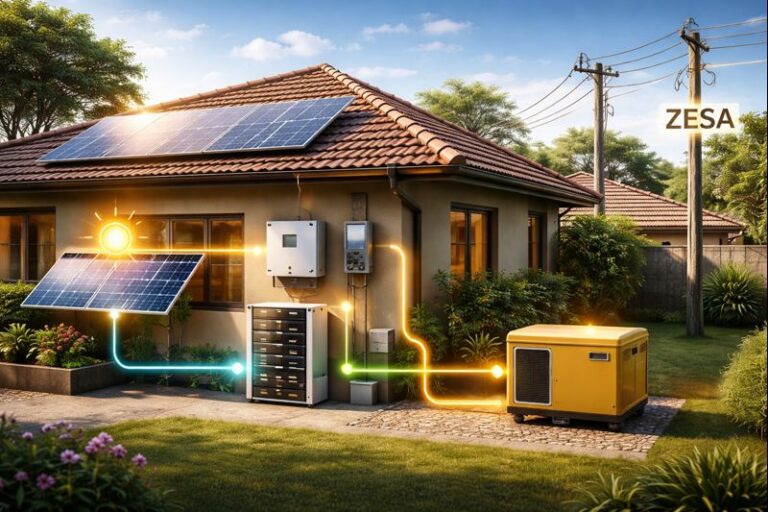
A hybrid inverter can manage:
- Solar panels
- Batteries
- ZESA grid power
- A generator (optional)
It automatically switches between these sources.
For example:
- During the day, it uses solar.
- At night, it uses batteries.
- When batteries are low, it pulls from ZESA.
- When ZESA goes off, it switches instantly to battery.
You do not need to flip switches.
In Zimbabwe, this automatic switching is not a luxury. It is survival.
If you only use a normal inverter, you lose flexibility.
If you use only a generator, you waste fuel.
A hybrid system gives you control.
Both Deye and Sunsync are hybrid inverters.
The difference lies in performance, configuration, and long-term reliability.
3. Deye and Sunsync: Basic Overview
3.1 What Is Deye?
Deye is a well-known hybrid inverter brand used widely in Africa.
In Zimbabwe, you commonly see:
- 5kW models for homes
- 8kW and above for businesses
- Larger commercial units
Deye offers:
- MPPT charging
- Lithium battery compatibility
- App monitoring
- Generator integration
It is known for strong hybrid capability and scalability.
3.2 What Is Sunsync?
Sunsync is also a hybrid inverter brand that has grown rapidly in Zimbabwe.
Common models include:
- 3.6kW
- 5kW
- 8kW
- 12kW and above
Sunsync focuses heavily on:
- Lithium battery integration
- Smart monitoring
- Load management
- Clean switching during outages
Both brands look similar on paper.
So where is the real difference?
Let’s go deeper.
4. Performance During Load Shedding
This is the most important section for Zimbabwe.
4.1 Switching Speed and Stability
When ZESA goes off, your inverter must:
- Switch instantly
- Maintain stable voltage
- Prevent flickering
Both Deye and Sunsync perform well here.
In properly installed systems:
- Lights do not flicker noticeably.
- WiFi stays connected.
- Fridges keep running smoothly.
For most homeowners, both brands handle switching effectively.
The real difference appears in configuration and system design.
If your installer configures it properly, both will handle load shedding well.
4.2 Voltage Fluctuations and Power Spikes
ZESA power can:
- Drop suddenly
- Return with high voltage
- Spike during storms
Both Deye and Sunsync include internal protections like:
- Overvoltage protection
- Undervoltage protection
- Overload protection
- Short circuit protection
However, internal protection is not enough.
In Zimbabwe, you must install:
- Surge protection devices
- Proper earthing
- Quality breakers
If you skip protection, no inverter brand will save you.
From a voltage stability perspective, both brands perform well when protected properly.
5. Lithium Battery Compatibility
Lithium batteries dominate the Zimbabwean market.
Why?
- They last longer.
- They charge faster.
- They handle daily cycling better.
5.1 Communication with Lithium Batteries
Both Deye and Sunsync support:
- CAN communication
- RS485 communication
- BMS integration
This improves:
- Charging accuracy
- Battery lifespan
- System safety
When paired with quality lithium batteries, both brands work well.
The key is proper configuration.
If your installer sets incorrect battery parameters:
- You reduce battery lifespan.
- You may experience early shutdowns.
- You may over-discharge batteries.
In Zimbabwe, battery configuration matters more than brand.
5.2 Daily Cycling Performance
Zimbabwe experiences daily load shedding.
That means:
- Batteries charge during the day.
- Batteries discharge at night.
- This cycle repeats almost every day.
Both Deye and Sunsync handle daily cycling well when paired with lithium batteries.
If you use gel batteries instead, performance drops over time regardless of brand.
For heavy daily cycling, both brands perform reliably.
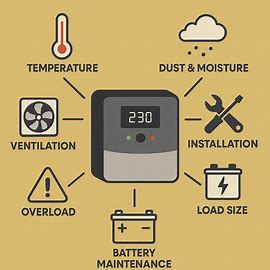
6. Heat, Dust and Zimbabwean Conditions
Zimbabwe gets hot.
In summer, temperatures exceed 30°C easily.
Dust is common, especially near gravel roads.
6.1 Heat Management
Both Deye and Sunsync include internal cooling systems.
However, installation determines performance.
If you install your inverter:
- In direct sunlight
- Inside a sealed cupboard
- In a poorly ventilated ceiling
When installed in:
- A cool
- Dry
- Well-ventilated space
Both brands handle Zimbabwean heat well.
6.2 Dust Exposure
Dust blocks airflow and increases internal temperature.
Neither brand is immune to dust buildup.
You must:
- Install in a clean location
- Avoid open exposure
- Maintain regular inspection
From a durability standpoint, both brands perform well when installed correctly.
7. Monitoring and Smart Features
Modern solar systems are not just hardware. They are software-driven.
7.1 App Monitoring
Both Deye and Sunsync offer monitoring apps.
You can track:
- Solar production
- Battery percentage
- Grid usage
- Load consumption
- Historical data
This helps you:
- Identify energy waste
- Adjust heavy appliance usage
- Detect faults early
For business owners, monitoring helps measure performance and ROI.
7.2 Smart Load Management
Both brands allow:
- Essential and non-essential load separation
- Custom battery discharge limits
- Grid priority settings
For example, you can set:
- “Use solar first”
- “Only use ZESA when battery drops below 20%”
- “Charge batteries during specific hours”
This flexibility matters in Zimbabwe.
Neither brand clearly dominates here. Both offer strong hybrid control.
8. Borehole and Pump Compatibility
Many Zimbabwean homes rely on boreholes.
A borehole pump requires:
- High startup current
- Stable inverter output
- Correct cable sizing
8.1 For Small Pumps
A properly sized 5kW inverter (Deye or Sunsync) can run:
- Small domestic borehole pumps
But you must ensure:
- Sufficient battery capacity
- Proper wiring
- Correct breaker sizing
8.2 For Larger Pumps and Farms
If you run:
- Large pumps
- Multiple pumps
- Farm irrigation
You need:
- 8kW and above
- Strong lithium battery bank
- Enough solar panels
Both brands support these setups.
Again, system design matters more than brand.
9. Deye vs Sunsync for Homes
If you own a 2–4 bedroom home and want:
- Lights
- WiFi
- TV
- Fridge
- Borehole pump
Both 5kW models perform well.
The real decision comes down to:
- Price at time of purchase
- Installer familiarity
- Warranty support
- Availability of stock
For average homeowners, both brands deliver reliable hybrid performance.
10. Deye vs Sunsync for Small Businesses
If you run:
- A salon
- A butchery
- An office
- A workshop
You need:
- Stable power
- Fast switching
- Battery protection
- Monitoring for tracking usage
Both brands perform well in SME environments.
For businesses, the real risk is downtime.
If power cuts cause:
- Stock spoilage
- Lost clients
- Interrupted services
Then hybrid solar becomes critical.
Both Deye and Sunsync reduce downtime significantly when properly sized.
11. Pricing and Value in Zimbabwe
Pricing changes based on:
- Exchange rates
- Supplier markup
- Installation materials
- Battery size
- Panel count
In general:
- Deye and Sunsync sit in a similar price range.
- Neither is considered “cheap.”
They are mid-to-premium hybrid inverters.
Do not judge based on inverter price alone.
Look at total system cost, including:
- Batteries
- Panels
- Protection equipment
- Installation quality
A cheap inverter with poor installation becomes expensive later.
12. Warranty and Local Support
Before buying either brand, confirm:
- Warranty duration
- Who handles claims
- Availability of local support
- Serial number verification
Both brands offer manufacturer warranties.
But local supplier reputation matters more.
If your supplier disappears after installation, brand reputation will not help you.
13. Where the Real Difference Lies
Here is the honest truth.
For most Zimbabwean users:
- Both Deye and Sunsync perform well.
- Both handle load shedding properly.
- Both integrate with lithium batteries.
- Both offer monitoring and hybrid control.
The bigger differences often come down to:
- Installer experience
- Firmware familiarity
- After-sales support
- Battery pairing
- System design quality
In real Zimbabwean conditions, installation quality affects performance more than brand.
14. Which One Should You Choose?
Choose Deye or Sunsync based on:
- Which brand your installer understands deeply
- Which has stronger warranty support in your area
- Which model fits your load requirements
- Which integrates best with your chosen battery
If your installer has installed 100 Deye systems successfully, that matters.
If your supplier stocks Sunsync parts locally, that matters.
Do not choose based on brand popularity alone.
Choose based on:
- System sizing
- Protection quality
- Battery capacity
- Long-term expansion plans
15. Final Verdict: Which Hybrid Inverter Is Better for Zimbabwe’s Load Shedding?
Here is the direct answer.
For Zimbabwe’s load shedding conditions:
There is no dramatic winner between Deye and Sunsync.
Both are strong hybrid inverters.
Both handle:
- Daily outages
- Voltage fluctuations
- Lithium integration
- Generator support
- Monitoring
The real winner is:
- Proper system design
- Correct battery sizing
- Quality installation
- Strong surge protection
If you size your system correctly and install it properly, either brand will serve you well.
If you cut corners on batteries, cables, or protection, neither brand will save you.
In Zimbabwe, hybrid solar is not about brand hype.
It is about reliability.
Choose wisely. Size correctly. Install professionally.
That is what truly determines whether your inverter survives load shedding.