Choosing the Right Solar Battery Capacity for Your Home (kWh Explained Simply)
1. Why Battery Size Matters More Than Brand
One of the most common questions people ask me is,
“Which solar battery should I buy?”
But here’s the truth most people don’t expect:
👉 Battery size matters more than battery brand.
I’ve seen homeowners spend a lot of money on well-known lithium batteries, only to discover that their system still can’t last through a full load-shedding cycle. I’ve also seen people overspend on battery capacity they don’t actually need.
That usually happens when people focus on:
- Brand names
- Price alone
- What a friend installed
Instead of focusing on the one thing that really determines performance:
battery capacity, measured in kilowatt-hours (kWh).
If you want your solar system to actually work for your home, you need to size the battery correctly — just like you would when sizing your entire solar system
Once you understand kWh, choosing the right battery becomes much easier — and far cheaper in the long run.
Table of Contents
2. What Does Solar Battery Capacity (kWh) Actually Mean?
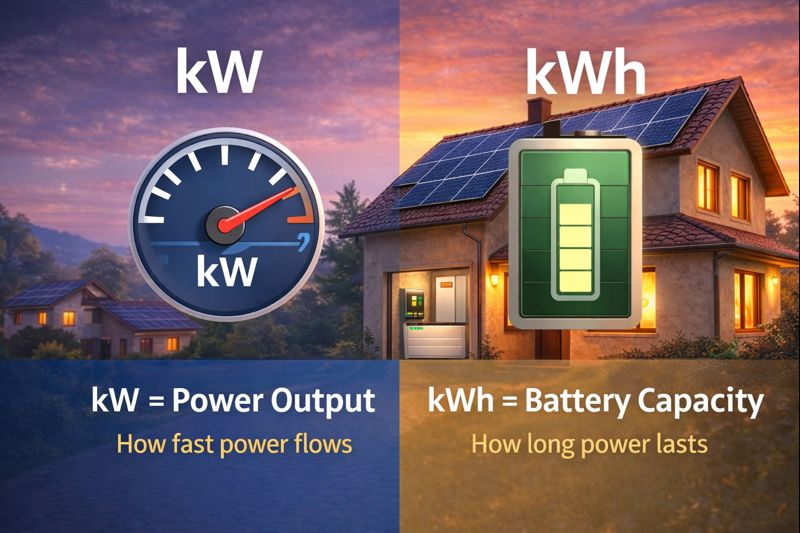
Let me break this down as simply as possible.
kWh tells you how long your battery can power your home
Think of your solar battery like a water tank:
- kWh is the size of the tank
- The bigger the tank, the longer it can supply water (or electricity)
So:
- A 5 kWh battery can supply 5 kilowatts of power for 1 hour
- Or 1 kilowatt of power for 5 hours
What confuses most people is mixing up:
- kW (power output)
- kWh (energy storage)
Your inverter handles power output, which is why choosing between regular and hybrid inverters also matters.
But your battery handles energy storage — how long things stay on when ZESA goes off.
That’s why someone with a powerful inverter but a small battery still experiences blackouts during long load shedding.
3. Common Solar Battery Sizes Used in Zimbabwean Homes
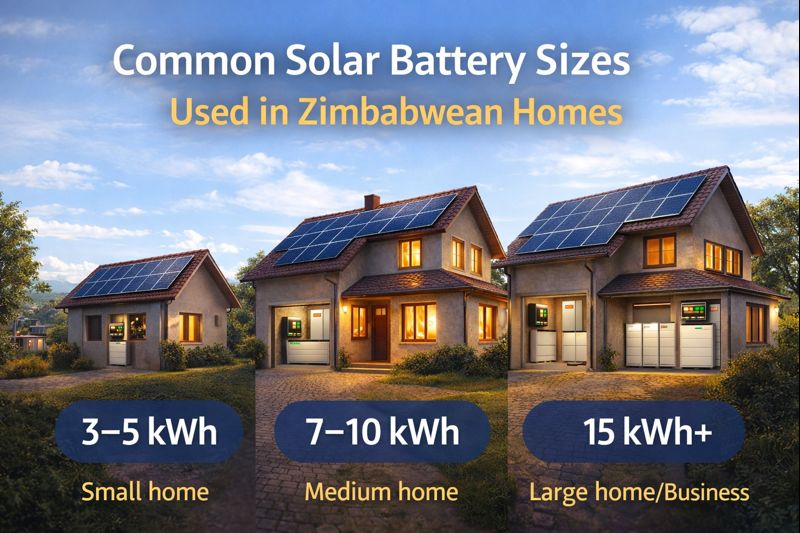
From my experience installing and advising on solar systems across Zimbabwe, most homes fall into one of these three categories.
3.1 Small Homes: 3–5 kWh Battery Capacity
This setup usually works well if you want to power:
- Lights
- Wi-Fi router
- TV
- Phone charging
It’s ideal for:
- Small households
- Flats
- Backup for short outages
However, I always warn clients that this size struggles during long load-shedding periods, especially if you add a fridge later.
3.2 Medium Homes: 7–10 kWh Battery Capacity
This is the most common choice for urban Zimbabwean homes.
A 7–10 kWh setup comfortably runs:
- Fridge
- TV
- Lights
- Wi-Fi
- Laptop charging
- Occasional small appliances
It also offers a good balance between:
- Runtime
- Cost
- Battery lifespan
If you’re curious about how long lithium batteries actually last in our climate, I explain that in detail here
3.3 Large Homes & Businesses: 15 kWh and Above
Larger systems are necessary when you want to power:
- Multiple fridges
- Borehole pumps
- Office equipment
- Extended daily usage
These setups are usually modular lithium systems, meaning you can expand capacity over time — if it’s done correctly.
This is also where professional advice becomes critical, because incorrect battery expansion can shorten battery life or void warranties.
4. How I Calculate the Right Battery Size for a Home
When someone asks me what battery size they need, I don’t guess — and I don’t start with brands.
I start with how the home actually uses power.
This is the same simple method I use with clients every day.
Step 1: List the appliances you MUST keep running
I always tell people to focus on essential appliances first, not everything in the house.
For most homes, that list looks like:
- Fridge
- TV
- Wi-Fi router
- Lights
- Phone and laptop charging
Step 2: Check the wattage of each appliance
You’ll usually find this:
- On the appliance label
- In the manual
- Or online
For example:
- Fridge: ±150 watts
- TV: ±100 watts
- Wi-Fi router: ±20 watts
- Lights: ±100 watts total
Step 3: Estimate how many hours you need backup power
In Zimbabwe, load shedding can last:
- 2–4 hours on good days
- 6–8 hours on bad days
Let’s assume 6 hours to be safe.
Step 4: Convert everything into kWh
Here’s a simple example:
- Total power usage: ±470 watts
- 470 watts × 6 hours = 2.8 kWh
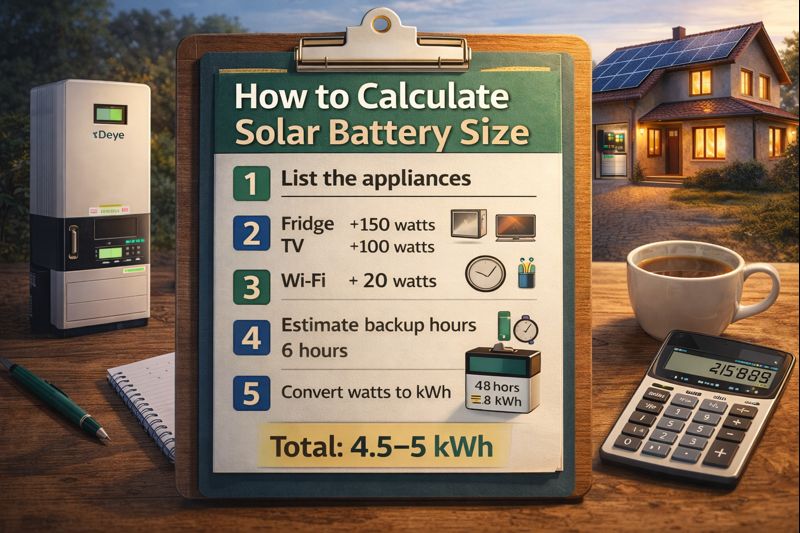
Step 5: Add a safety margin
I always add 20–30% extra capacity to account for:
- Battery losses
- Unexpected appliance use
- Battery ageing over time
So instead of 2.8 kWh, I’d recommend:
- At least a 4–5 kWh battery
This same thinking applies when sizing your entire solar system, not just the battery
5. Load Shedding Reality in Zimbabwe: Why Runtime Matters
This is where many systems fail — not because they’re badly built, but because they were undersized for real-world conditions.

I always remind people that:
- Marketing brochures assume perfect conditions
- Load shedding in Zimbabwe is rarely predictable
Why small batteries struggle
A 5 kWh battery might look fine on paper, but in practice:
- Fridges cycle on and off
- Power demand spikes in the evening
- Inverter settings affect consumption
During long outages, that small buffer disappears quickly.
This problem becomes worse if:
- The inverter is incorrectly sized
- The system isn’t configured properly
That’s why understanding what affects inverter lifespan and performance is also important.
What I recommend instead
If you regularly experience:
- Evening load shedding
- Overnight outages
- Back-to-back cuts
Then choosing a slightly larger battery capacity gives you:
- Longer runtime
- Less stress on the battery
- Better long-term reliability
In my experience, oversizing slightly is always cheaper than replacing batteries early.
6. Battery Capacity vs Budget: How I Help People Balance Cost and Performance
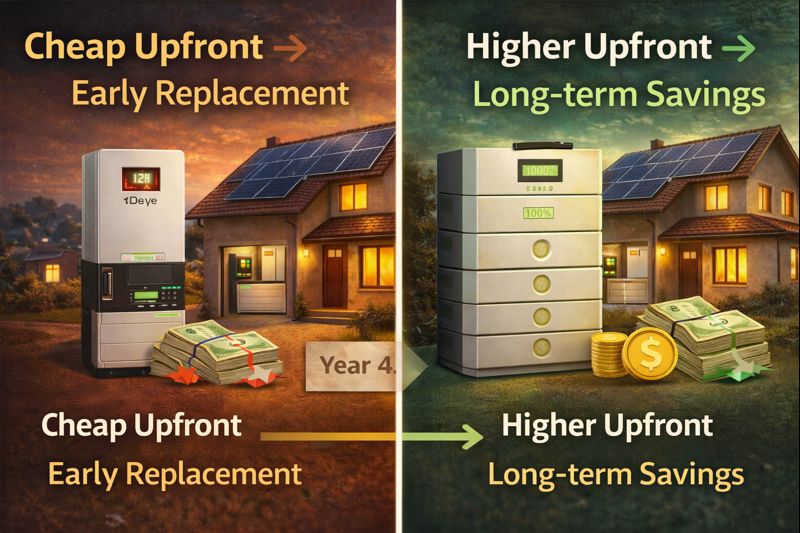
I understand budgets are real — not everyone can install the biggest battery available.
The key is spending smart, not spending blindly.
Why the cheapest battery often costs the most
I’ve seen this many times:
- Someone buys the smallest battery to save money
- It runs flat every day
- It degrades faster
- They end up replacing it early
This usually leads to the exact problem I describe in the lithium ion batteries hype overrated or still relevant article
My practical approach to budgeting
Here’s how I guide people:
- Buy enough capacity for today’s needs
- Choose a modular lithium system if future expansion is planned
- Avoid mixing brands or battery ages later
Cutting corners at the battery stage often leads to:
- Poor performance
- Warranty issues
- Higher costs down the line
If you’re unsure how much capacity you can realistically afford, it’s better to:
- Power fewer appliances reliably
- Than try to power everything poorly
That’s how you protect both your investment and your peace of mind.
7. Common Battery Sizing Mistakes I See All the Time
Over the years, I’ve noticed that most battery problems don’t come from faulty products — they come from poor sizing decisions.
Here are the most common mistakes I see almost every week.
Choosing a battery based on inverter size only
Many people assume that if they buy a 5 kVA inverter, a small battery will be enough. Unfortunately, inverter size tells you how much power can flow, not how long it will last.
Ignoring future power needs
People often size batteries only for today’s appliances, then add:
- A second fridge
- A borehole pump
- Extra lights
Suddenly, the battery that once felt “perfect” becomes inadequate.
Running batteries flat every day
Daily deep discharges significantly shorten battery lifespan. This is one of the clearest signs your solar battery needs replacing.
Skipping system protection
Undersized or poorly protected systems experience voltage stress, surges, and premature failures. That’s why I always insist on proper solar system protection kits.
Avoiding these mistakes alone can save you thousands over the life of your system.
8. Can You Upgrade Your Battery Capacity Later?
Yes — but only if it’s done correctly.
Most modern lithium systems allow expansion, but I always caution clients about a few important rules.
When upgrades work well
- Same battery brand
- Same battery model
- Similar battery age
- Proper inverter compatibility
This approach allows you to grow your system gradually without compromising performance.
When upgrades cause problems
- Mixing old and new batteries
- Combining different brands
- Expanding without checking inverter limits
These mistakes often lead to:
- Uneven charging
- Faster degradation
- Warranty issues
If you’re planning for future expansion, it’s best to choose the right foundation from the start — even if you don’t install all the capacity immediately.
9. Final Advice: Let Your Usage Guide Your Battery Choice
If there’s one thing I want you to take away from this guide, it’s this:
Your battery should match your lifestyle — not marketing promises.
The right battery capacity:
- Keeps your essentials running through load shedding
- Reduces stress on the system
- Lasts longer
- Saves you money over time
Solar trends in Zimbabwe clearly show that homeowners are moving toward better-sized, smarter systems, not just cheaper ones.
When you understand kWh properly, battery sizing stops being confusing — and starts making financial sense.
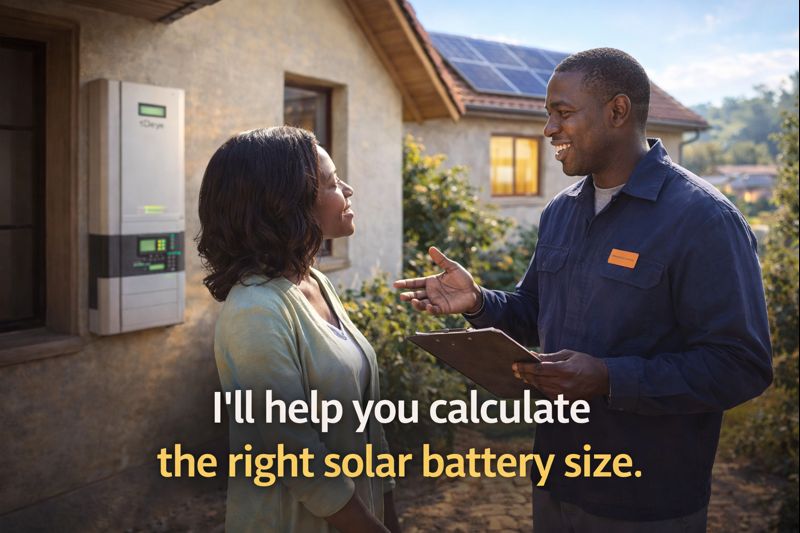
Your Next Step: Let’s Size Your Battery the Right Way
If you’re still unsure what battery capacity fits your home, you’re not alone — and you don’t have to figure it out by trial and error.
I help homeowners every day to:
- Assess their real power needs
- Choose the right battery size
- Avoid overspending or undersizing
- Build systems that actually last
Whether you’re installing solar for the first time or upgrading an existing system, a proper load assessment makes all the difference.
Contact Solar Power Shop Zimbabwe for a free consultation and let’s design a battery setup that works for your home, your budget, and your load-shedding reality.