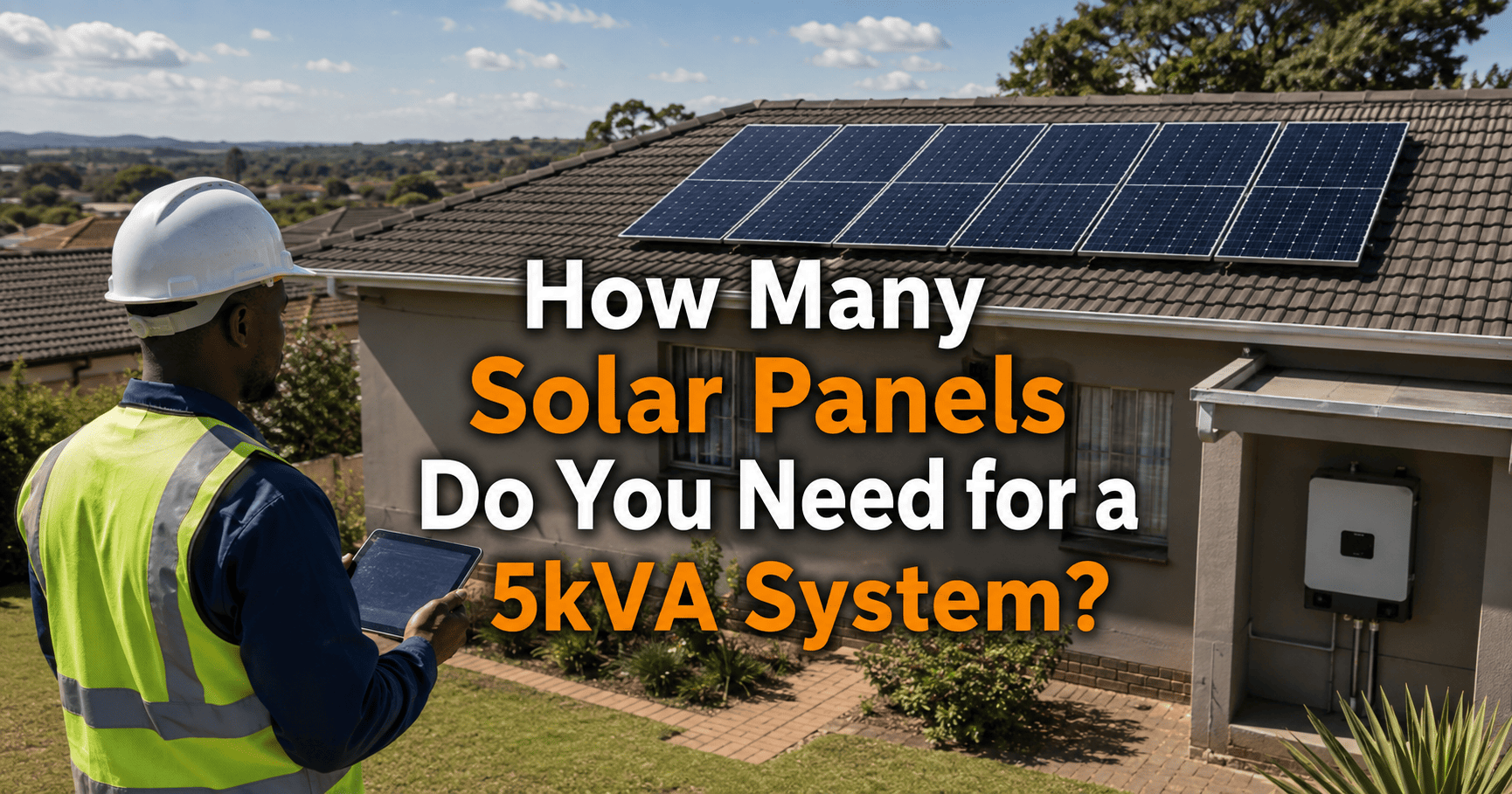
How Many Solar Panels Do You Need for a 5kVA System?
A common question among homeowners buying solar in Zimbabwe is: How many solar panels do I need for a 5kVA system?
The quick answer is that there is no single number that applies to every 5kVA system.
Solar Power Shop’s standard 5kVA hybrid kit uses six 450W monocrystalline solar panels, giving it a combined rated solar-panel capacity of 2.7kWp.
However, another 5kVA system may use five higher-wattage panels, nine panels or even twelve panels. The correct number depends on:
- The wattage of each solar panel
- Your daily energy consumption
- The battery capacity
- How quickly the battery must recharge
- Daytime appliance use
- Available roof space
- Shading and panel orientation
- The inverter’s photovoltaic voltage and current limits
- Whether the system is primarily for backup or greater solar independence
This guide explains the calculations, why a 5kVA inverter does not automatically require exactly 5kW of solar panels and how to determine a suitable panel configuration.
The Short Answer
Solar Power Shop’s standard 5kVA hybrid kit includes:
- 6 × 450W monocrystalline solar panels
- 1 × 48V 100Ah lithium-ion battery
- 1 × 5.5kVA hybrid inverter
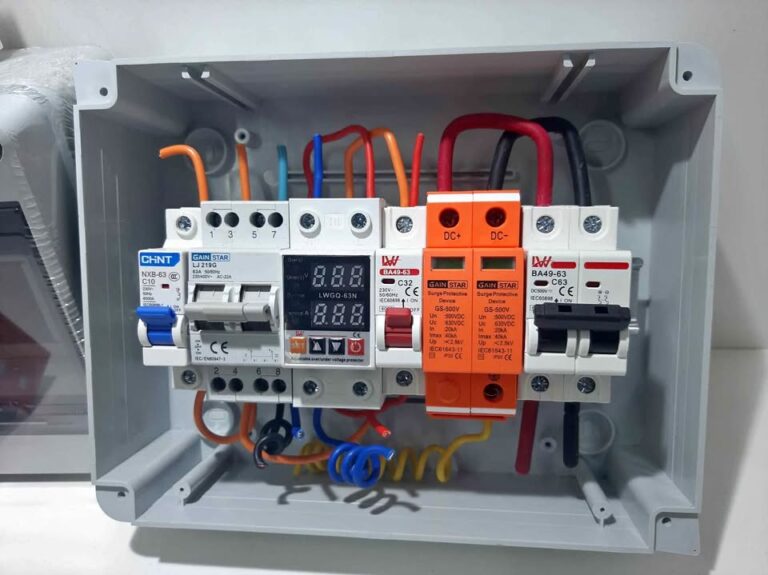
- Protection kit
- Mounting kit
- Cables
The total rated panel capacity is:
6 × 450W = 2,700W, or 2.7kWp
This configuration is designed as a balanced starting package for typical household requirements. It does not mean every 5kVA inverter should always have six panels.
You can view the complete package on the Solar Power Shop hybrid solar kits page.
Why a 5kVA Inverter Does Not Automatically Need 5kW of Panels
The inverter rating and solar-panel capacity describe different parts of the system.
The inverter rating describes instantaneous load capacity
A 5kVA inverter indicates how much electrical load the inverter can supply at a particular moment, subject to its power factor, continuous-output specifications and surge limits.
It answers a question such as:
How many appliances can the inverter supply at the same time?
The solar-panel rating describes generation capacity
Solar panels are rated in watts under standard test conditions. Their combined capacity indicates the maximum rated DC output of the array under those conditions.
It answers a different question:
How much solar power can the panels potentially generate under suitable sunlight?
A 5kVA inverter can therefore operate with a solar array smaller than 5kWp if the system is designed for moderate energy consumption and uses ZESA or another source when necessary.
It may also support a solar array close to or above 5kWp if the manufacturer’s photovoltaic input specifications permit it.
Never determine the panel count from the inverter’s kVA rating alone.
The United States Department of Energy’s solar photovoltaic system design overview similarly explains that panels, inverters, mounting structures and other components must be designed as parts of one complete system.
How Panel Wattage Changes the Number Required
Higher-wattage panels produce more rated power per panel, so fewer panels may be required to reach a particular array capacity.
For example, suppose you want approximately 2.7kWp of solar-panel capacity:
| Panel wattage | Calculation | Practical panel count | Resulting array |
|---|---|---|---|
| 365W | 2,700 ÷ 365 | 8 panels | 2.92kWp |
| 440W | 2,700 ÷ 440 | 7 panels | 3.08kWp |
| 450W | 2,700 ÷ 450 | 6 panels | 2.70kWp |
| 555W | 2,700 ÷ 555 | 5 panels | 2.78kWp |
| 580W | 2,700 ÷ 580 | 5 panels | 2.90kWp |
The mathematical panel count is not the final design.
The proposed panels must still form valid electrical strings that comply with the inverter’s:
- Minimum MPPT operating voltage
- Maximum MPPT voltage
- Maximum open-circuit voltage
- Maximum input current
- Number of MPPT inputs
- Maximum permitted PV-array power
A professional installer must confirm these values using the exact inverter and solar-panel datasheets.
How Many 450W Panels Are Needed?
Solar Power Shop’s standard package uses six 450W panels:
6 × 450W = 2,700W
If the goal were to install approximately 5kWp of panels, the mathematical calculation would be:
5,000W ÷ 450W = 11.11
Since you cannot install part of a panel, this would normally be rounded to a practical configuration such as 12 panels:
12 × 450W = 5,400W, or 5.4kWp
However, you must not connect twelve panels merely because the calculation reaches approximately 5kW. The series and parallel arrangement must remain within the exact inverter’s PV-input limits.
How Many 555W Panels Are Needed?
To achieve approximately 2.7kWp:
2,700W ÷ 555W = 4.86
This suggests five panels:
5 × 555W = 2,775W, or 2.775kWp
To achieve approximately 5kWp:
5,000W ÷ 555W = 9.01
Nine panels provide:
9 × 555W = 4,995W, or approximately 5kWp
Again, the panel count must be checked against the inverter’s minimum string voltage and maximum input limits. A mathematically convenient number may not produce a valid electrical string.
Solar Power Shop also lists a 555W Jinko solar panel for customers comparing higher-wattage modules.
How Many 580W Panels Are Needed?
To reach approximately 2.7kWp:
2,700W ÷ 580W = 4.66
Five panels provide:
5 × 580W = 2,900W, or 2.9kWp
To reach approximately 5kWp:
5,000W ÷ 580W = 8.62
Nine panels provide:
9 × 580W = 5,220W, or 5.22kWp
Whether five or nine panels can be used depends on the voltage and current specifications of both the panels and inverter.
Should the Solar Array Match the Inverter Size?
Not necessarily.
A 5kVA inverter does not require exactly 5kWp of solar panels. The best array size depends on how the system will be used.
A smaller array may be suitable when:
- Solar is primarily used for backup
- ZESA is available for supplementary charging
- Daily household consumption is modest
- The battery bank is relatively small
- Heavy appliances are used infrequently
- The customer has a limited initial budget
- The system will be expanded later
A larger array may be suitable when:
- Appliances operate extensively during the day
- Faster battery recharging is required
- The system has additional battery capacity
- Load shedding regularly lasts for extended periods
- The customer wants greater solar independence
- The property has refrigeration, office or business loads
- The inverter supports the additional PV capacity
A larger array does not increase the inverter’s AC output rating. It increases the solar energy potentially available for active loads and battery charging.
Start With Daily Energy Consumption
The most useful panel-sizing question is not:
How large is the inverter?
It is:
How many kilowatt-hours does the household need each day?
Consider this illustrative daily-energy estimate:
| Appliance group | Estimated daily consumption |
|---|---|
| LED lighting | 0.5kWh |
| Television and decoder | 0.6kWh |
| Wi-Fi router | 0.4kWh |
| Laptops and charging | 0.8kWh |
| Refrigerator | 1.5kWh |
| Deep freezer | 1.8kWh |
| Selected kitchen appliances | 1.0kWh |
| Other moderate loads | 1.0kWh |
| Illustrative total | 7.6kWh per day |
Actual consumption may be much higher or lower. Use appliance labels, measured energy consumption and realistic operating times rather than relying only on generic estimates.
Our previous guide explains what a 5kVA solar system can run in Zimbabwe and why simultaneous load differs from daily energy consumption.
A Simple Solar-Panel Sizing Formula
A simplified planning formula is:
Required array size = Daily energy requirement ÷ Peak-sun-hours assumption ÷ System-efficiency factor
For example, suppose a household needs 10kWh per day and the preliminary calculation assumes:
- 5 equivalent peak-sun-hours
- A 75% overall production factor after allowing for temperature, dirt, wiring, conversion and other losses
The calculation becomes:
10kWh ÷ 5 ÷ 0.75 = 2.67kWp
With 450W panels:
2,670W ÷ 450W = 5.93 panels
This produces a preliminary estimate of six 450W panels.
That is an energy-yield calculation, not an electrical string design. The installer must still check the array against the inverter and panel specifications.
Solar-resource conditions vary by location, season and installation. The World Bank-supported Global Solar Atlas for Zimbabwe provides independent information about the country’s solar resource and photovoltaic power potential.
Examples Based on Different Daily Energy Requirements
The following examples use five equivalent peak-sun-hours and a 75% production factor strictly for illustration.
Household requiring 5kWh per day
5kWh ÷ 5 ÷ 0.75 = 1.33kWp
Using 450W panels:
1,330W ÷ 450W = 2.96
Preliminary estimate: 3 × 450W panels
This may be mathematically sufficient for the assumed daily energy, but three panels may not satisfy the inverter’s minimum MPPT voltage. Electrical compatibility must be checked.
Household requiring 10kWh per day
10kWh ÷ 5 ÷ 0.75 = 2.67kWp
Using 450W panels:
Preliminary estimate: 6 × 450W panels
This closely matches Solar Power Shop’s standard 5kVA package.
Household requiring 15kWh per day
15kWh ÷ 5 ÷ 0.75 = 4kWp
Using 450W panels:
4,000W ÷ 450W = 8.89
Preliminary estimate: 9 × 450W panels
The inverter specifications must confirm whether the resulting string arrangement is acceptable.
Household requiring 20kWh per day
20kWh ÷ 5 ÷ 0.75 = 5.33kWp
Using 450W panels:
5,330W ÷ 450W = 11.84
Preliminary estimate: 12 × 450W panels
This represents a much more energy-intensive household. The battery bank and inverter PV-input capacity must also be evaluated.
Why Peak Sun Hours Are Not the Same as Daylight Hours
Zimbabwe may have daylight for many hours, but panels do not produce their rated output evenly throughout the day.
Production usually rises in the morning, reaches its strongest period around the middle of the day and falls toward sunset.
An equivalent peak-sun-hour figure converts varying solar radiation into an easier energy calculation. It does not mean the panels produce full rated power for that exact number of clock hours.
Output changes according to:
- Location
- Season
- Weather
- Panel angle
- Panel direction
- Shading
- Temperature
- Dirt and dust
- Equipment efficiency
Any preliminary peak-sun-hours assumption should be replaced with location-specific resource and system data during detailed design.
Why the 48V 100Ah Battery Matters
The standard 5kVA package includes a 48V 100Ah lithium-ion battery with approximately:
48V × 100Ah = 4,800Wh, or 4.8kWh nominal capacity
The battery’s usable energy will be lower than its nominal figure because of:
- The permitted depth of discharge
- Battery-management settings
- Inverter losses
- Temperature
- Battery condition
- Reserve settings
The solar array must provide enough energy to:
- Run daytime household loads
- Recharge the energy removed from the battery
- Cover normal system losses
- Prepare the system for evening and overnight use
If panels only produce enough energy for the active daytime load, little may remain for battery charging.
Likewise, adding more battery capacity without checking the solar array can result in batteries that take too long to recharge.
Read our guide to choosing the right solar battery capacity before expanding the battery bank.
The Inverter’s PV Limits Come First
Before connecting any panels, obtain the exact inverter datasheet and identify:
- Maximum PV-array power
- Maximum PV open-circuit voltage
- MPPT operating-voltage range
- Maximum PV input current
- Maximum short-circuit current
- Number of MPPTs
- Maximum current per MPPT
Then obtain the solar-panel datasheet and identify:
- Maximum power
- Open-circuit voltage
- Voltage at maximum power
- Short-circuit current
- Current at maximum power
- Temperature coefficients
- Maximum system voltage
These values determine how many panels can be connected in series and how many strings can be connected in parallel.
Series connections increase voltage
When panels are connected in series, their voltages add while the string current remains approximately the same.
Parallel connections increase current
When equal strings are connected in parallel, their currents add while the voltage remains approximately the same.
Exceeding the inverter’s voltage limit can damage equipment. Exceeding current or array-power limits can also cause faults, clipping or unsafe operation.
Panel-string design must therefore be completed by a competent solar professional.
Do Not Mix Different Panels Carelessly
Mixing different panel models can reduce performance and complicate system design.
Differences may include:
- Wattage
- Voltage
- Current
- Cell technology
- Age
- Degradation
- Temperature behaviour
When mismatched panels are connected in one series string, the lower-current module can restrict the string. Parallel strings with different voltages can also perform poorly.
When expanding a system, use compatible modules and confirm the proposed configuration with the inverter specifications.
What Effect Does Shading Have?
Even limited shading can reduce solar production, particularly when it affects modules connected within the same string.
Common sources of shading include:
- Trees
- Chimneys
- Water tanks
- Satellite dishes
- Nearby buildings
- Roof sections
- Utility poles
- New construction
A proper site assessment should check shading throughout the day and consider seasonal changes in the sun’s path.
The United States Department of Energy’s solar PV specification and site-assessment guide recommends evaluating orientation, tilt and shading before finalising an array location.
Do not install extra panels simply to compensate for a poorly selected, heavily shaded position if a better array location is available.
Roof Space and Panel Size
Higher-wattage panels can reduce the number of modules needed, but they may also be physically larger.
The installer must consider:
- Roof dimensions
- Usable roof sections
- Panel dimensions
- Required gaps
- Roof condition
- Structural suitability
- Access for maintenance
- Panel orientation
- Mounting system
- Wind loading
A five-panel array made from large modern modules may not necessarily occupy half the space of a ten-panel array made from smaller modules.
Panel dimensions should be checked directly from the product datasheet before planning the roof layout.
What Happens on Cloudy Days?
Solar panels still generate electricity under cloudy conditions, but output is normally lower than under strong direct sunlight.
The reduction depends on cloud density, weather conditions, panel technology and the rest of the system.
A system expected to operate reliably through periods of poor weather may require:
- Additional panel capacity
- More battery storage
- ZESA support
- Generator support
- Reduced non-essential consumption
- Careful load scheduling
Read Do Solar Panels Work on Cloudy Days? for a fuller explanation.
Can You Add More Panels Later?
A 5kVA system may be expandable, but expansion depends on the inverter’s remaining PV capacity and electrical limits.
Before adding panels, check:
- Whether the inverter has unused MPPT capacity
- Whether the new string voltage is valid
- Whether input-current limits will be exceeded
- Whether the existing panels are still available
- Whether new and existing modules are compatible
- Whether the roof has suitable unshaded space
- Whether cables and protection equipment remain correctly sized
- Whether the battery bank can accept the available charging current
Do not connect additional panels simply because physical roof space is available.
Panel Direction, Tilt and Maintenance
Correct orientation and tilt help the array make better use of available sunlight.
The best design depends on the property, roof shape and any shading obstacles. The array should also be accessible for safe inspection and cleaning.
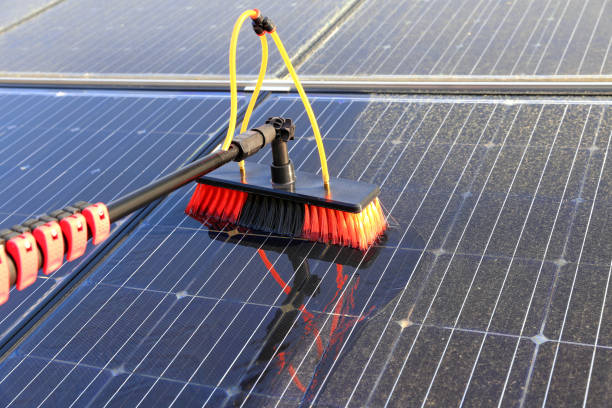
Zimbabwe’s dry and dusty conditions can allow dirt to accumulate on panel surfaces. This may reduce production if panels are not maintained appropriately.
Follow our guide on maintaining solar panels in Zimbabwe’s dusty climate.
The United States Department of Energy notes that system output is affected by factors including temperature, shading, soiling and conductor resistance in its photovoltaic-system modelling guidance.
Monocrystalline or Polycrystalline Panels?
The standard Solar Power Shop kit uses monocrystalline panels.
Monocrystalline panels are widely used where customers want higher wattage from a practical roof area. However, panel quality, warranty, voltage, current, temperature performance and compatibility are more important than relying only on the technology label.
Our guide comparing monocrystalline and polycrystalline solar panels explains the differences.
Common Panel-Sizing Mistakes
Matching panel wattage directly to inverter kVA
A 5kVA inverter does not automatically require exactly 5kWp of panels.
Ignoring daily energy consumption
The array must be designed around energy use and charging requirements, not only simultaneous appliance load.
Ignoring battery size
An array that is acceptable for one battery configuration may recharge an expanded battery bank too slowly.
Exceeding inverter voltage
Too many panels connected in series can exceed the inverter’s maximum PV voltage.
Exceeding input current
Incorrect parallel-string design can exceed an MPPT’s input-current limit.
Ignoring cold-weather voltage rise
Panel open-circuit voltage changes with temperature. String calculations must include the relevant temperature coefficient and local conditions.
Using the panel’s wattage as guaranteed output
A 450W panel does not produce exactly 450W throughout the day. Its rating is measured under standard test conditions.
Installing panels in shade
Adding more panels does not always solve poor array positioning.
Mixing incompatible modules
Different panel electrical characteristics can reduce performance.
Expanding without upgrading protection
Changes to the array may require reassessment of isolators, breakers, surge protection, cabling and earthing.
Learn why protection is important in our article about solar protection kits and electrical faults.
Frequently Asked Questions
How many 450W panels does a 5kVA solar system need?
Solar Power Shop’s standard 5kVA package uses six 450W panels, providing 2.7kWp. A household requiring greater daily production may need more panels if the inverter specifications permit them.
Can I use five 555W panels on a 5kVA inverter?
Five 555W panels provide approximately 2.775kWp. Whether they form a valid string depends on the panels’ voltage and current and the inverter’s MPPT operating range.
Do I need twelve 450W panels for a 5kVA inverter?
Twelve 450W panels provide 5.4kWp. Some 5kVA-class inverters may support an array around this size, while others may not support the proposed string arrangement. Check the exact datasheets before installation.
Is six panels enough for a 5kVA system?
Six 450W panels may be sufficient for a moderate household and one 48V 100Ah battery, as used in Solar Power Shop’s standard kit. Sufficiency ultimately depends on daily consumption, charging requirements, sunlight and system losses.
Can a 5kVA inverter work with only four panels?
Possibly, but the combined string voltage may be below the inverter’s minimum MPPT operating range. The panel and inverter datasheets must be checked.
Can too many solar panels damage an inverter?
An incorrectly designed array can exceed the inverter’s maximum voltage, current or permitted PV-array power. This can cause faults, unsafe operation or equipment damage.
Do more panels increase battery runtime at night?
Panels do not directly increase the battery’s storage capacity. They can help recharge the battery more quickly and power daytime loads, but nighttime runtime still depends mainly on usable battery energy and the connected load.
Should I add batteries or solar panels first?
That depends on the problem. If the battery reaches full charge early but runs out overnight, more storage may be needed. If the battery regularly fails to recharge fully, more compatible panel capacity or lower consumption may be required.
Get the Correct Panel Configuration
The number of solar panels needed for a 5kVA system cannot be determined from inverter size alone.
Solar Power Shop’s standard system uses six 450W panels, but the correct configuration for your property depends on:
- Daily energy consumption
- Battery capacity
- Daytime appliance use
- Required charging speed
- Roof space
- Shading
- Panel wattage
- Inverter PV limits
- Plans for future expansion
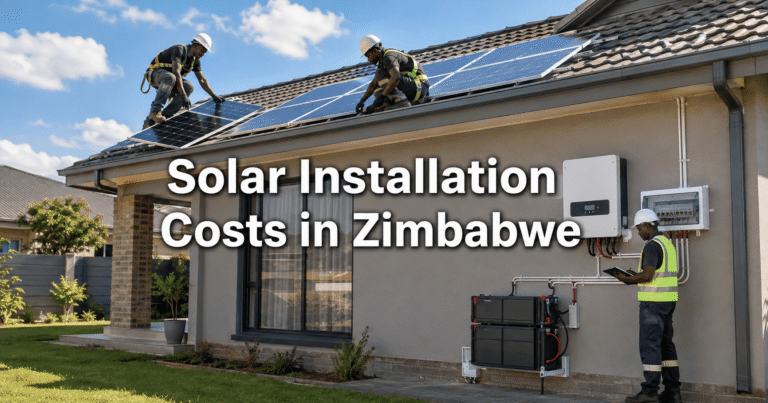
Solar Power Shop installs solar systems throughout Zimbabwe. Customers can visit either branch or contact the company online for an assessment and detailed quotation.
Compare the available hybrid solar kits or request a custom quotation for a system designed around your appliances, property and energy requirements.
The calculations in this guide are preliminary examples. Final panel quantities and string configurations must be based on the exact inverter, battery and solar-panel specifications and a professional site assessment.