What Can a 5kVA Solar System Run in Zimbabwe?
A 5kVA solar system is one of the most popular options for Zimbabwean households that want more than basic backup power. It can support lighting, entertainment, refrigeration, internet equipment and several everyday appliances when the system is properly designed and the loads are managed carefully.
However, a 5kVA inverter does not automatically mean you can run every appliance in the house simultaneously.
The system’s real performance depends on:
- The inverter’s continuous and surge capacity
- The capacity and usable energy of the battery
- The number and wattage of the solar panels
- The starting requirements of appliances such as refrigerators and pumps
- How many appliances are used at the same time
- How long each appliance operates
- Available sunlight and panel orientation
- Whether ZESA or a generator is available as an additional source
This guide explains what a 5kVA solar system can realistically run in a Zimbabwean home, which appliances require careful management and why battery capacity matters as much as inverter size.
What Is Included in Solar Power Shop’s 5kVA Kit?
The standard 5kVA hybrid kit offered by Solar Power Shop includes:
- 6 × 450W monocrystalline solar panels
- 1 × 48V 100Ah lithium-ion battery
- 1 × 5.5kVA hybrid inverter
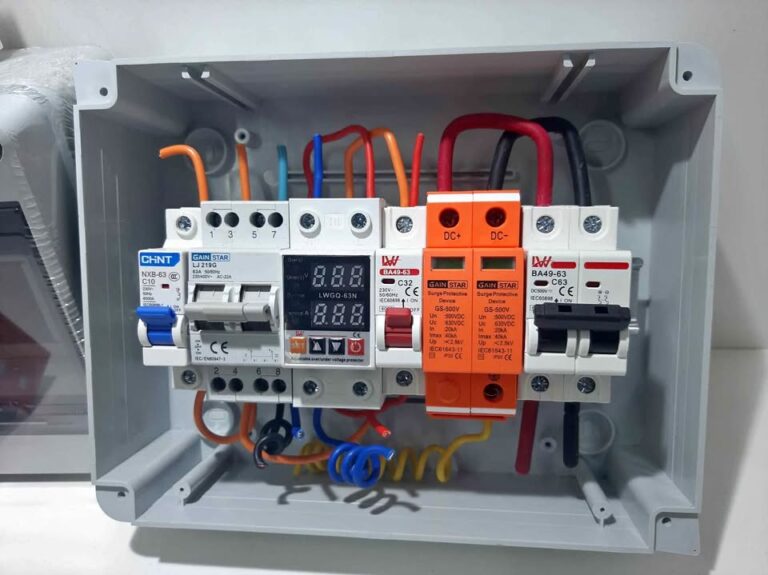
- Protection kit
- Mounting kit
- Cables
The six panels provide a combined rated solar-panel capacity of:
6 × 450W = 2,700W, or 2.7kWp
The 48V 100Ah battery has a nominal energy capacity of approximately:
48V × 100Ah = 4,800Wh, or 4.8kWh
Nominal battery capacity is not the same as the energy that will reach your appliances. The battery’s permitted depth of discharge, inverter efficiency, system settings, temperature and battery condition all affect usable energy.
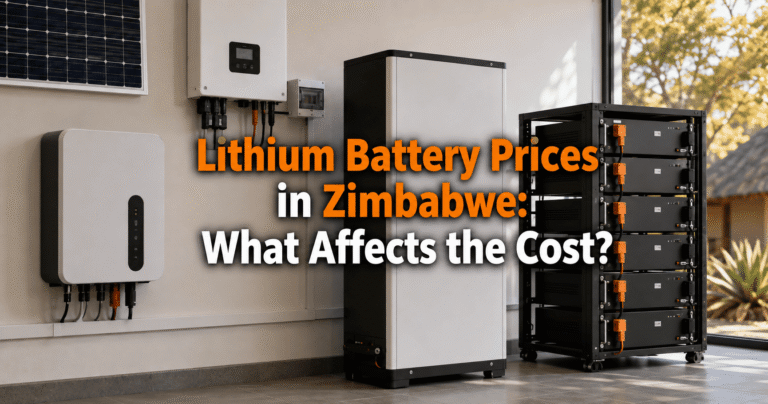
You can view the package and its current price on the Solar Power Shop hybrid solar kits page. For a comparison with smaller packages, see our Solar System Prices in Zimbabwe: Buyer’s Guide.
The Short Answer: What Can a 5kVA Solar System Run?
A properly configured 5kVA system can generally support a practical combination of:
- LED lights
- Television and decoder
- Wi-Fi router
- Laptops and desktop computers
- Phone charging
- Refrigerator
- Deep freezer
- Security system
- Electric fence
- Gate motor
- Selected kitchen appliances used for short periods
- Washing machine, depending on its power requirements and heating settings
- A suitably sized borehole or pressure pump, subject to starting requirements
- Other moderate household loads
This does not mean every appliance on this list should operate at once.
Heavy heating appliances such as electric stoves, ovens, kettles, geysers and irons can consume a large portion of the inverter’s available capacity. They can also discharge the battery much faster than televisions, lights or internet equipment.
Understanding the Difference Between kVA and kWh
Many solar buyers use the terms kVA and kWh as if they mean the same thing, but they measure different parts of the system.
kVA describes inverter capacity
The inverter rating indicates how much electrical load it can supply at a particular moment.
A 5kVA or 5.5kVA inverter has significantly more load-handling ability than a 1kVA or 3kVA inverter. However, its exact usable output in kilowatts depends on the inverter specifications and the power factor of the connected loads.
kWh describes stored or consumed energy
Battery capacity is measured in kilowatt-hours.
A battery with approximately 4.8kWh of nominal storage does not provide unlimited operating time simply because it is connected to a 5kVA inverter.
For example:
- A small load may run for several hours.
- A 2kW appliance may use a large portion of the battery in a relatively short time.
- A combination of heavy appliances can discharge the battery rapidly even if the inverter can technically supply them.
This is why a 5kVA inverter with one 48V 100Ah battery behaves differently from the same inverter connected to two or more compatible batteries.
Read our guide to choosing the right solar battery capacity for a simpler explanation of kWh and battery runtime.
Typical Appliance Power Requirements
The following figures are broad planning estimates, not guaranteed ratings. Appliance consumption differs according to brand, model, size, age, efficiency and operating mode.
| Appliance | Illustrative power range |
|---|---|
| LED light | 5W–15W |
| Wi-Fi router | 10W–25W |
| Television | 60W–200W |
| Laptop | 40W–100W |
| Desktop computer and monitor | 150W–400W |
| Refrigerator while compressor is running | 100W–300W |
| Deep freezer while compressor is running | 150W–400W |
| Microwave | 1,000W–1,800W |
| Electric kettle | 1,800W–2,200W |
| Electric iron | 1,000W–2,000W |
| Washing machine | 400W–2,500W, depending on heating |
| Small air conditioner | Approximately 800W–1,500W or more |
| Borehole or pressure pump | Varies significantly by motor and head |
| Electric stove plate | Approximately 1,000W–2,500W |
| Electric oven | Approximately 2,000W–3,500W |
| Electric geyser | Commonly 2,000W–4,000W or more |
Always check the appliance nameplate or manufacturer’s manual before sizing a solar system. The United States Department of Energy’s appliance guidance also recommends using appliance energy information and actual usage patterns when estimating consumption.
A Realistic Essential-Loads Example
Consider a home using:
- 8 LED lights at 10W each: 80W
- Television: 120W
- Decoder: 25W
- Wi-Fi router: 20W
- Two laptops at 65W each: 130W
- Refrigerator while running: 200W
- Deep freezer while running: 250W
If every appliance in this example were drawing its estimated running power simultaneously, the combined load would be:
80W + 120W + 25W + 20W + 130W + 200W + 250W = 825W
This is comfortably below the inverter’s headline capacity.
However, refrigerators and freezers do not consume one fixed amount of power continuously. Their compressors switch on and off, and the starting demand can be higher than the normal running demand.
The actual battery runtime will also depend on:
- How often the compressors operate
- The age and efficiency of the appliances
- Room temperature
- Door-opening frequency
- Battery state of charge
- Whether solar panels are producing power at the time
Energy-efficient refrigerators can reduce the load placed on a solar system. ENERGY STAR’s refrigerator guidance explains how compressor efficiency, insulation and temperature controls affect consumption.
How Long Can the Battery Last?
Solar Power Shop’s standard kit contains a 48V 100Ah lithium-ion battery with approximately 4.8kWh of nominal energy.
The full nominal capacity should not automatically be used for runtime calculations. The battery management system, permitted depth of discharge and inverter losses reduce the energy available at the output.
For illustration, if approximately 3.5kWh to 4kWh ultimately reaches the appliances:
| Average combined load | Approximate illustrative runtime |
|---|---|
| 300W | About 11–13 hours |
| 500W | About 7–8 hours |
| 800W | About 4–5 hours |
| 1,000W | About 3.5–4 hours |
| 2,000W | About 1.75–2 hours |
| 3,000W | About 1–1.3 hours |
These are simplified estimates. They exclude changing appliance loads, battery reserve settings, battery ageing and solar energy being produced while the appliances operate.
Actual performance must be calculated using the specifications of the supplied battery and inverter.
Why Daytime Performance Is Different
During suitable daylight, the solar panels can supply energy to the appliances while also charging the battery, depending on the system configuration and available power.
The six 450W panels have a combined rated capacity of 2.7kWp, but that does not mean they continuously produce 2.7kW from sunrise to sunset.
Solar output changes according to:
- Time of day
- Season
- Cloud cover
- Panel orientation and angle
- Dust and dirt
- Shading
- Temperature
- Cable and conversion losses
Zimbabwe has a strong solar resource, but performance still differs by location and installation conditions. The World Bank-supported Global Solar Atlas provides non-commercial solar-resource and photovoltaic-potential information for Zimbabwe.
Running heavier appliances during strong daylight can reduce the amount of energy drawn from the battery. At night, those appliances depend mainly on battery storage, ZESA or a connected generator.
Can a 5kVA Solar System Run a Refrigerator and Deep Freezer?
In many correctly designed installations, yes.
A refrigerator and deep freezer usually draw moderate power while their compressors are operating. The main issues are:
- Compressor starting surge
- The age and efficiency of the appliances
- Whether other heavy loads operate simultaneously
- Required overnight runtime
- The battery’s usable capacity
A modern refrigerator and freezer combined with lighting, Wi-Fi and entertainment equipment can form a sensible load profile for a 5kVA system.
Old or poorly maintained refrigeration equipment can consume more energy. Damaged door seals, poor ventilation and placing a refrigerator near a heat source can also increase consumption.
Can It Run a Kettle?
A 5kVA-class inverter can generally supply an ordinary electric kettle if the total simultaneous load remains within its limits.
However, a kettle commonly draws around 2kW. This makes it a heavy load, even though it normally operates for only a few minutes.
A 2kW kettle used for ten minutes consumes approximately:
2kW × 10/60 hours = 0.33kWh
Occasional daytime use may be practical, but repeatedly boiling a kettle at night consumes stored battery energy quickly.
Avoid using the kettle while other heavy appliances such as an iron, microwave, pump or stove are operating.
Can It Run a Microwave?
A microwave may be used for short periods if its rated input power and the combined household load remain within the inverter’s capacity.
Do not calculate using only the cooking-power figure advertised on the front of the microwave. Check the electrical input rating on the appliance label or manual because it may be higher than the advertised cooking output.
Using a microwave while a kettle, iron or pump is running can push the combined load closer to the inverter limit.
Can It Run an Electric Stove and Oven?
A 5kVA system should not be assumed to support a complete four-plate stove and oven as an unrestricted household load.
One stove plate may draw approximately 1kW to 2.5kW, while an oven may require another 2kW to 3.5kW. Using multiple plates and the oven can exceed the inverter’s practical capacity and discharge a single battery very quickly.
If electric cooking is important, consider:
- A larger inverter
- Additional battery capacity
- More solar panels
- Cooking mainly during strong daylight
- An induction cooker or efficient small appliance
- A gas-and-solar cooking combination
- Strict management of simultaneous loads
Our detailed article, Can a 4 Plate Electric Stove and Oven Run on Solar in Zimbabwe?, explains the calculations and practical limitations.
Can It Run a Washing Machine?
It may run a washing machine, but the machine’s settings matter.
A washing machine using cold water may have relatively moderate power requirements. A machine that heats its own water can draw much more power because the heating element becomes the dominant load.
For better results:
- Use cold-water or eco cycles
- Run the machine during strong daylight
- Avoid using a kettle, iron or microwave simultaneously
- Check the nameplate input rating
- Allow for motor starting requirements
A tumble dryer is a different load and can require substantially more energy. It should be assessed separately.
Can It Run a Borehole Pump?
Possibly, but a pump should never be added based only on its horsepower rating.
A pump motor can require a strong surge when starting. Suitability depends on:
- Motor power
- Starting current
- Pump type
- Borehole depth
- Total pumping head
- Pipe size
- Water-flow requirement
- Pump controller
- Other household loads running at the same time
Even when the running power appears acceptable, the starting demand may trip or overload an inadequately sized inverter.
If the property depends on borehole water, provide the pump nameplate details and borehole information during the system assessment. You can also read our guide to solar panels for boreholes in Zimbabwe.
Can It Run an Air Conditioner?
A small, efficient air conditioner may operate on a 5kVA system if:
- The inverter can handle its starting and running requirements
- Other heavy appliances are controlled
- There is sufficient battery capacity
- The air conditioner does not need to operate for long periods at night
Air conditioning can consume significant energy over several hours. A system that can start an air conditioner may still have insufficient battery storage to run it throughout the night.
An inverter-type air conditioner is generally easier to integrate than an older fixed-speed unit, but its actual nameplate and operating requirements must still be checked.
Can It Run a Geyser?
An ordinary electric geyser is a heavy resistive load and can consume a large amount of stored energy.
A 5kVA inverter may technically supply some geyser elements when other loads are limited, but this does not automatically make it an efficient or practical use of a single 48V 100Ah battery.
Better options may include:
- A dedicated solar geyser
- Heating water during strong daylight
- A timer or smart control
- A lower-wattage element, where professionally approved
- Additional solar panels and battery storage
The geyser must not be treated as a minor background appliance.
Appliances You Should Not Run Together
A 5kVA system becomes much easier to manage when high-power appliances are scheduled instead of used simultaneously.
Avoid combinations such as:
- Kettle and electric iron
- Kettle and microwave
- Microwave and geyser
- Borehole pump and kettle
- Washing machine water heater and iron
- Electric stove and oven with other household loads
- Air conditioner and multiple cooking appliances
A useful rule is to operate only one major heating or motor load at a time unless the system assessment confirms otherwise.
What Happens When the System Is Overloaded?
If connected loads exceed the inverter’s limits, the inverter may:
- Sound an alarm
- Display an overload warning
- Disconnect the output
- Restart after the load is removed
- Enter fault protection
Repeated overloads can make the system unreliable and may shorten equipment life.
Overloading should not be solved by bypassing protection devices or increasing breaker sizes without professional assessment. The inverter, wiring, protection equipment and distribution circuits must work as one correctly designed system.
The Zimbabwe Energy Regulatory Authority publishes electricity regulations and technical guidance relevant to safe electrical systems in Zimbabwe.
Why a Load Assessment Is Essential
Two households can own the same 5kVA inverter and have completely different experiences.
One household may run:
- A refrigerator
- Television
- Wi-Fi
- Lights
- Laptops
Another may expect the same system to run:
- A borehole pump
- Electric geyser
- Stove
- Oven
- Kettle
- Freezer
- Air conditioner
The inverter label may be identical, but the second household has a much larger energy and surge requirement.
A load assessment should record:
- Appliance name
- Running wattage
- Starting or surge requirement
- Quantity
- Daily operating hours
- Whether it is essential during load shedding
- Whether it will operate during the day or at night
Use our step-by-step solar system sizing guide to begin compiling this information.
When Should You Add Another Battery?
Additional compatible battery capacity may be necessary when:
- Essential appliances must operate throughout the night
- Load shedding regularly lasts for extended periods
- The home uses multiple refrigerators or freezers
- A home office must remain operational
- The existing battery reaches its reserve level too quickly
- High-consumption appliances are used regularly
- There is insufficient time to recharge between outages
Adding battery capacity can improve runtime, but the inverter settings, battery communication, charge current and solar-panel capacity must remain compatible.
Do not connect batteries of different voltages, chemistries, capacities or conditions without professional approval.
When Should You Add More Solar Panels?
Additional panel capacity may be considered when:
- The battery does not recharge fully during normal sunlight
- Daytime consumption uses most of the available solar production
- Battery capacity has been expanded
- The property has increased its daily energy consumption
- Seasonal or site conditions reduce production
The inverter has specific limits for photovoltaic voltage, current and total panel capacity. Panels must not be added without checking those limits and confirming the proposed string configuration.
Can the System Work With ZESA and a Generator?
Yes, a hybrid inverter can be configured to work with solar panels, batteries and another available source such as ZESA. Some installations may also integrate a generator, subject to the inverter design and correct configuration.
A typical priority arrangement may be:
- Solar powers the active household loads.
- Excess solar charges the battery.
- The battery supplies power when solar production falls.
- ZESA or a generator assists according to the configured settings.
The exact sequence depends on the inverter, installation and customer preferences.
Read how hybrid solar systems combine batteries, ZESA and generators for a more detailed explanation.
How to Get Better Performance From a 5kVA System
Run heavy appliances during daylight
Using energy directly while the panels are producing reduces unnecessary battery discharge.
Avoid unnecessary simultaneous loads
Do not operate several heating appliances at once.
Choose energy-efficient appliances
Efficient refrigerators, freezers, lights and electronics reduce both inverter load and daily battery consumption.
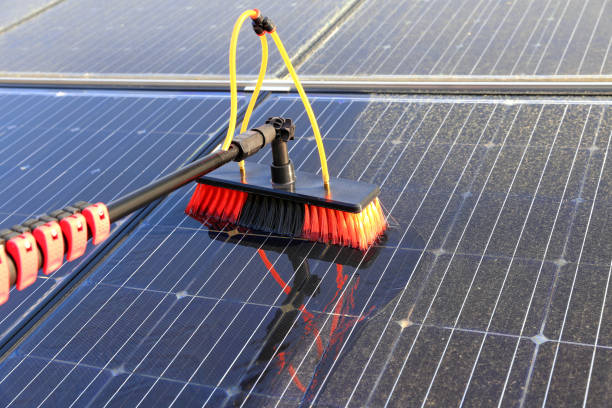
Keep solar panels clean
Dust and dirt can reduce production. Follow appropriate cleaning and safety practices or use a professional service.
See our guide to maintaining solar panels in Zimbabwe’s dusty climate.
Monitor the system
Pay attention to:
- Current household load
- Battery state of charge
- Solar production
- Grid input
- Fault warnings
- Historical consumption
Monitoring helps identify which appliances are consuming the most power.
Protect the installation
Correct earthing, breakers, isolators and surge protection help protect the inverter, batteries, panels and household equipment.
Learn how protection kits help prevent damage from lightning, power surges and ZESA faults.
Frequently Asked Questions
Can a 5kVA solar system run a whole house?
It can run many essential household appliances, but “the whole house” depends on what the house contains. A home using lights, refrigeration, Wi-Fi and entertainment equipment has very different requirements from one using electric cooking, geysers, pumps and air conditioning.
How many solar panels are needed for a 5kVA system?
The standard Solar Power Shop kit includes six 450W monocrystalline panels, providing 2.7kWp of rated panel capacity. The appropriate number for another system depends on the inverter’s photovoltaic specifications, battery size, energy usage and installation conditions.
How many batteries are needed for a 5kVA inverter?
There is no universal number. The standard package includes one 48V 100Ah lithium-ion battery. Customers requiring longer backup may need additional compatible storage after a proper assessment.
Can a 5kVA system run two refrigerators?
It may run two refrigerators if their running and starting requirements, combined with the other loads, remain within the system limits. Battery runtime and appliance efficiency must also be considered.
Can a 5kVA system run a borehole pump?
It may run a suitably sized pump, but the motor’s starting current, borehole depth, pumping head and other connected loads must be assessed first.
Can a 5kVA inverter run a kettle and microwave?
It may be able to run either appliance, but using them simultaneously can consume a large portion of the available inverter capacity. Use one major heating appliance at a time.
Can a 5kVA solar system run an electric stove?
It may run a single stove plate under controlled conditions, but a complete four-plate stove and oven can exceed the system’s practical capacity and drain the battery rapidly.
How long will a 48V 100Ah battery last?
It depends on the usable battery capacity and combined load. A modest load can run for several hours, while heavy cooking or water-heating appliances can discharge it much faster.
Is a 5kVA Solar System Right for Your Home?
A 5kVA solar system is a practical option for many Zimbabwean homes, but it must be matched to the appliances and expected operating time.
It is generally well suited to households prioritising:
- Lighting
- Refrigeration
- Entertainment
- Internet access
- Computers
- Security equipment
- Carefully managed kitchen appliances
It may need more battery storage, additional panel capacity or a larger inverter when the household requires:
- Full electric cooking
- Long air-conditioner runtime
- Electric water heating
- Large pumps
- Several heavy appliances at once
- Extended off-grid operation
Solar Power Shop installs solar systems throughout Zimbabwe. Customers can visit either branch or communicate online to request an assessment covering the equipment, installation, additional site materials and delivery where applicable.
View the 5kVA hybrid solar package or request a custom quotation based on the appliances you need to power.
Appliance figures and runtime examples in this guide are illustrative. Always use the actual appliance nameplates and equipment specifications when designing or expanding a solar system.