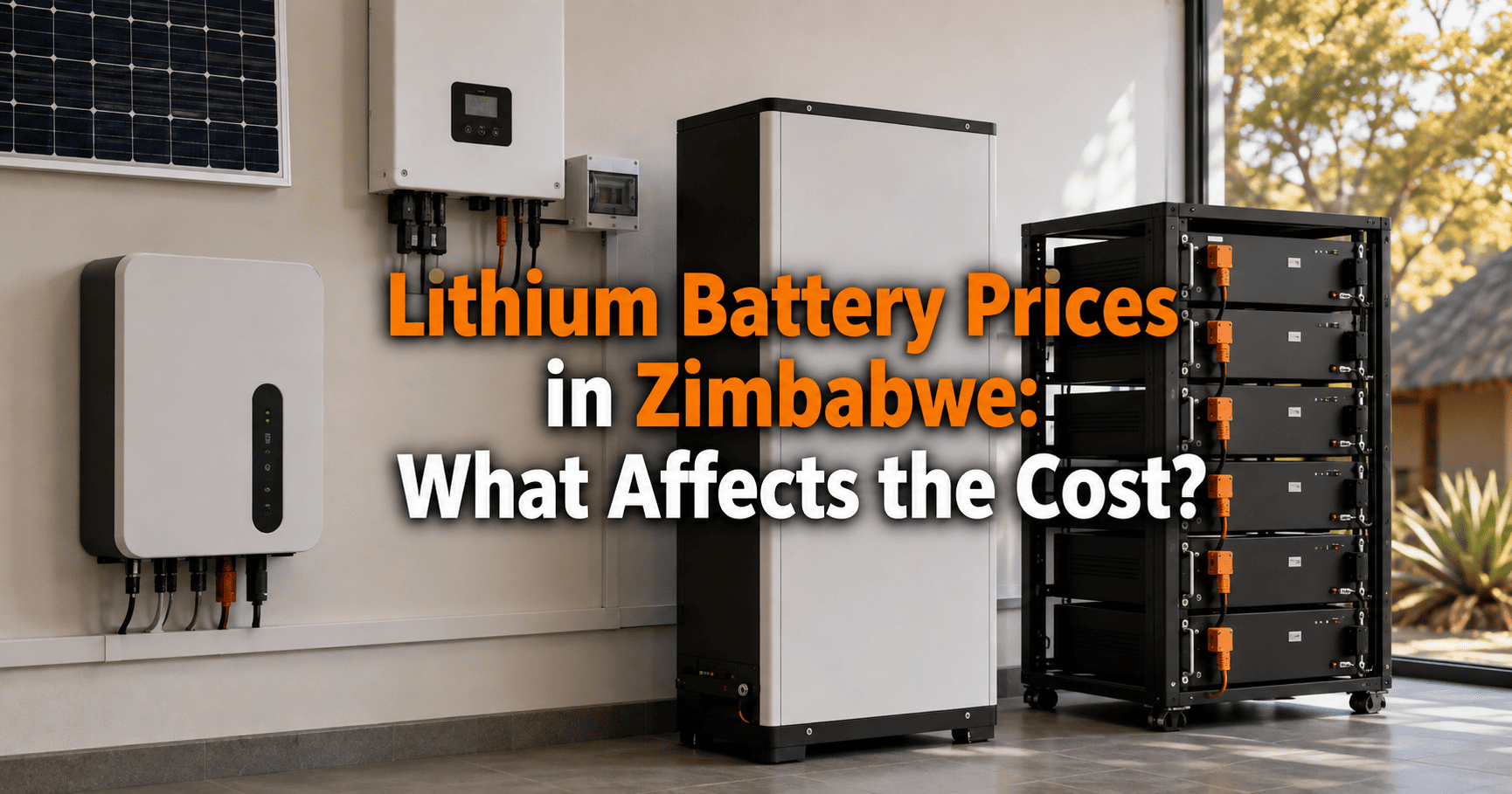
Lithium Battery Prices in Zimbabwe: What Affects the Cost?
Lithium battery prices in Zimbabwe vary considerably. A 24V 100Ah battery may cost around US$330 to US$350, while a 48V battery can range from approximately US$750 to more than US$1,300.
The difference is not based only on the brand name.
Battery voltage, usable storage capacity, cell quality, battery-management features, charging current, inverter communication, cycle life, warranty and local support can all affect the final price.
This is why comparing batteries only by the “100Ah” label can be misleading. A 24V 100Ah battery and a 48V 100Ah battery have the same amp-hour number, but the 48V battery stores approximately twice as much nominal energy.
This guide compares lithium battery prices currently listed by Solar Power Shop and explains what Zimbabwean homeowners should examine before buying.
Important: Battery prices, promotions and availability may change. Always check the current product listing or contact Solar Power Shop before making a purchase.
Quick Comparison of Lithium Battery Prices in Zimbabwe
The following examples are based on Solar Power Shop’s listed prices at the time this guide was prepared:
| Lithium battery | Nominal energy calculation | Listed price |
|---|---|---|
| 24V 100Ah Polaris lithium battery | Approximately 2.4kWh | US$330 |
| 24V 100Ah MUST lithium battery | Approximately 2.4kWh | US$350 |
| 24V 100Ah SVOLT lithium battery | Approximately 2.4kWh | US$350 |
| 48V 100Ah Polaris lithium battery | Approximately 4.8kWh | US$750 |
| Pylontech 48V UP5000 lithium battery | Approximately 4.8kWh class | US$1,100 |
| 48V 100Ah Deye lithium battery | Approximately 4.8kWh | US$1,300 |
These are product prices. Installation, delivery, communication cables, additional protection equipment and other site-specific requirements may be quoted separately where applicable.
You can check current availability and prices in the Solar Power Shop catalogue.
Why Amp-Hours Alone Do Not Tell You the Battery Size
One of the most common mistakes when comparing solar batteries is looking only at amp-hours.
Battery energy is calculated approximately as:
Voltage × Amp-hours = Watt-hours
To convert watt-hours to kilowatt-hours, divide by 1,000.
24V 100Ah battery
24V × 100Ah = 2,400Wh
That is approximately:
2.4kWh nominal capacity
48V 100Ah battery
48V × 100Ah = 4,800Wh
That is approximately:
4.8kWh nominal capacity
The 48V battery therefore stores approximately twice the nominal energy of a 24V battery with the same 100Ah rating.
This is one reason a 48V 100Ah battery normally costs considerably more than a 24V 100Ah battery.
However, nominal capacity is not necessarily the amount of energy that reaches your appliances. The battery-management system, depth-of-discharge limit, inverter efficiency and operating conditions all affect usable capacity.
Current 24V Lithium Battery Options
24V 100Ah Polaris Lithium Battery – US$330
The 24V 100Ah Polaris lithium-ion battery is listed at US$330.
Its nominal energy capacity is approximately:
24V × 100Ah = 2.4kWh
A battery in this range may suit compatible 24V solar systems used for:
- Household lighting
- Television and entertainment
- Wi-Fi
- Laptops
- Refrigeration, subject to system sizing
- Other modest backup loads
The inverter must support the battery voltage and appropriate lithium charging settings.
24V 100Ah MUST Lithium Battery – US$350
The 24V 100Ah MUST lithium-ion battery is listed at US$350.
A MUST battery may be attractive to customers already using a compatible MUST inverter. Brand matching can sometimes simplify settings or battery communication, although compatibility must still be confirmed using the exact model numbers.
Read our assessment of how reliable MUST inverters are in Zimbabwe before choosing a complete MUST-based setup.
24V 100Ah SVOLT Lithium Battery – US$350
The 24V 100Ah SVOLT lithium-ion battery is also listed at US$350.
As with the other 24V options, the buyer should confirm:
- Actual rated capacity
- Recommended charge voltage
- Maximum charging current
- Maximum continuous discharge current
- Battery-management features
- Inverter compatibility
- Communication options
- Warranty terms
Two batteries with similar voltage and amp-hours may still have different internal cells, current limits and communication features.
Current 48V Lithium Battery Options
48V 100Ah Polaris Lithium Battery – US$750
The 48V 100Ah Polaris lithium-ion battery is listed at US$750.
Its approximate nominal energy capacity is:
48V × 100Ah = 4.8kWh
A 48V battery is commonly used with larger household solar systems, including many 5kVA-class hybrid inverters.
Solar Power Shop’s standard 5kVA package includes a 48V 100Ah lithium battery. Read what a 5kVA solar system can run in Zimbabwe for realistic appliance and runtime examples.
Pylontech 48V UP5000 Lithium Battery – US$1,100
The Pylontech 48V UP5000 lithium battery is listed at US$1,100.
Batteries in this category may cost more because buyers are not paying for cells alone. The price may also reflect:
- Battery-management design
- Communication support
- Compatibility with supported inverter models
- Expansion capability
- Enclosure and rack design
- Brand history
- Published technical documentation
- Warranty and after-sales support
Always confirm the exact model specifications because the product name, URL and technical documentation should refer to the same battery model.
48V 100Ah Deye Lithium Battery – US$1,300
The 48V 100Ah Deye lithium battery is listed at US$1,300.
A Deye battery may be considered by customers building a compatible Deye-based system or prioritising direct inverter-to-battery communication.
However, buying the most expensive battery does not automatically create the best system. The inverter, battery, solar array and expected loads must be correctly matched.
Customers comparing compatible inverters can also review the available Deye 5kW hybrid inverter.
What Factors Affect Lithium Battery Prices?
1. Battery Voltage
Voltage is one of the clearest price factors.
Common residential solar-system voltages include:
- 12V
- 24V
- 48V or a similar nominal high-voltage class
Larger inverter systems generally use higher battery voltages to deliver substantial power with lower current than an equivalent lower-voltage configuration.
You cannot choose battery voltage according to price alone. It must match the inverter’s supported battery-voltage range.
A 24V battery cannot simply replace a 48V battery, and a 48V battery must not be connected to an inverter designed only for 24V.
2. Energy Capacity in kWh
Kilowatt-hours provide a more useful comparison than amp-hours alone.
A battery with more usable kWh can run a given load for longer.
For example, ignoring losses for a simplified illustration:
- A 2.4kWh battery contains half the nominal energy of a 4.8kWh battery.
- Two compatible 4.8kWh batteries provide approximately 9.6kWh nominal storage.
- Higher storage capacity normally increases the purchase price.
When comparing prices, calculate:
Battery price ÷ usable kWh = approximate cost per usable kWh
Use usable capacity rather than nominal capacity whenever the manufacturer publishes it.
3. Cell Chemistry
“Lithium-ion” refers to a broad family of battery chemistries.
Many stationary solar batteries use lithium iron phosphate, commonly written as:
- LiFePO4
- LFP
Other lithium-ion chemistries are also used in different applications.
Chemistry influences:
- Energy density
- Thermal behaviour
- Charging characteristics
- Cycle life
- Safety design
- Weight
- Cost
- Suitable operating conditions
The United States Department of Energy’s lithium-ion technology assessment explains that lithium-ion is a class of different electrochemical systems rather than one identical battery technology.
Before purchasing, check the actual chemistry stated in the manufacturer’s datasheet.
4. Cell Quality and Consistency
A battery pack contains individual cells assembled into a larger system.
Cell quality affects:
- Capacity consistency
- Internal resistance
- Heat generation
- Charging balance
- Long-term degradation
- Reliability under high loads
Two batteries can use the same chemistry and advertise the same capacity while using cells of different quality grades or manufacturing consistency.
A cheaper battery may perform acceptably for light use but struggle under repeated high-current charging and discharging.
Because buyers cannot easily inspect sealed internal cells, product documentation, warranty, supplier reputation and real support become important.
5. Usable Depth of Discharge
Depth of discharge describes how much of the battery’s stored energy is removed during use.
A 4.8kWh nominal battery does not necessarily provide 4.8kWh to the appliances.
For example, if the manufacturer permits 90% usable depth of discharge:
4.8kWh × 90% = 4.32kWh
The inverter then introduces conversion losses before the energy reaches AC appliances.
Another battery may reserve more capacity to protect the cells, resulting in lower usable energy.
Compare:
- Nominal capacity
- Usable capacity
- Recommended depth of discharge
- Warranty conditions at the stated depth of discharge
Do not assume that every lithium battery can safely be discharged to zero.
6. Cycle Life
One battery may be advertised for fewer charge-discharge cycles than another.
Cycle life is affected by:
- Depth of discharge
- Charge rate
- Discharge rate
- Temperature
- Cell chemistry
- Cell quality
- Battery-management settings
- How the manufacturer defines the end of battery life
A cycle-life claim should state the testing conditions and the remaining capacity expected at the end of those cycles.
A battery advertised for many cycles may cost more initially but offer better long-term value if the claim is supported by a credible warranty and correct operation.
Our article on how long lithium batteries last in Zimbabwe’s climate explains how temperature and daily usage influence lifespan.
7. Calendar Life
Batteries also age with time, even when they do not complete a full cycle every day.
Calendar ageing means a battery cannot be expected to last indefinitely merely because it has completed fewer than its advertised cycles.
Calendar life is influenced by:
- Temperature
- Average state of charge
- Storage conditions
- Cell chemistry
- Manufacturing quality
- Time spent fully charged
- Time spent deeply discharged
When comparing warranties, look at both the time period and the cycle or energy-throughput conditions.
8. Battery-Management System Quality
The battery-management system, or BMS, monitors and protects the battery pack.
Its responsibilities may include:
- Monitoring individual cell voltage
- Balancing cells
- Measuring temperature
- Limiting charge current
- Limiting discharge current
- Disconnecting unsafe loads
- Preventing overcharging
- Preventing excessive discharge
- Recording faults
- Communicating with the inverter
A more capable BMS can increase battery cost, but it is a critical part of a safe and reliable lithium battery.
The battery should not be purchased as if the BMS were an optional accessory.
9. Inverter Communication
Some lithium batteries communicate with compatible inverters through protocols and connections such as:
- CAN
- RS485
Communication can allow the battery to report:
- State of charge
- Voltage
- Current
- Temperature
- Alarm status
- Permitted charge current
- Permitted discharge current
Without supported communication, the inverter may need carefully configured user-defined voltage and current settings.
Compatibility must be confirmed using the exact battery and inverter model numbers. A communication port being physically present does not guarantee that two products understand the same protocol.
10. Charge and Discharge Current
Two batteries with the same energy capacity may have different power-delivery limits.
The maximum continuous discharge current affects how much load the battery can support.
The maximum charge current affects how quickly the battery can safely recharge.
A battery designed for higher current may require:
- More capable cells
- A stronger BMS
- Larger internal conductors
- Improved thermal management
- Heavier terminals
- A more robust enclosure
These factors can increase cost.
A large inverter connected to a battery with an inadequate discharge-current rating may experience battery protection trips when heavy loads are used.
11. Brand and Inverter Ecosystem
Established brands may charge more for:
- Product development
- Compatibility testing
- Firmware
- Technical documentation
- Monitoring integration
- Distributor networks
- Warranty administration
- Replacement support
Brand reputation alone should not replace technical comparison, but local product support can be valuable when faults occur.
The lowest-priced battery may become expensive if no technician can diagnose it, no replacement parts are available and the warranty cannot be honoured locally.
12. Warranty Terms
Do not compare warranties only by the number of years printed on the box.
Check:
- Who provides the warranty
- Where claims are submitted
- Whether the supplier is established locally
- Permitted depth of discharge
- Cycle limits
- Energy-throughput limits
- Remaining-capacity guarantee
- Approved inverter settings
- Temperature requirements
- Installation requirements
- Excluded causes of damage
- Whether labour and transport are covered
A clear, enforceable warranty may contribute to a higher price.
13. Safety Testing and Certification
Battery design must address electrical, thermal and mechanical risks.
Safety features and recognised testing may increase manufacturing costs but provide important evidence that the product has been evaluated against defined requirements.
The United States Department of Energy’s energy-storage safety strategy highlights the importance of codes, standards, procurement, installation and commissioning throughout an energy-storage system’s lifecycle.
Customers should request credible product documentation rather than relying only on marketing claims.
14. Enclosure and Installation Format
Lithium solar batteries may be:
- Wall mounted
- Floor standing
- Rack mounted
- Cabinet mounted
The enclosure affects:
- Physical protection
- Cooling
- Cable access
- Installation space
- Service access
- Dust resistance
- Moisture resistance
- Appearance
- Expansion options
A robust enclosure, rack system or weather-resistant design can increase cost.
The installation area must still comply with manufacturer requirements. Batteries should not be exposed to direct sunlight, water, excessive heat or unsafe household traffic.
15. Expandability
Some battery systems are designed to connect multiple compatible modules in parallel.
An expandable design may include:
- Communication between batteries
- Defined master and slave arrangements
- Approved parallel cables
- Address switches
- Rack mounting
- Firmware support
- Current-sharing controls
Expansion must follow the manufacturer’s requirements.
Do not mix:
- Different voltages
- Different battery chemistries
- Incompatible brands
- Batteries with very different capacities
- Old and new batteries without approval
- Models with incompatible firmware
A battery that is easy to expand may cost more but provide a better long-term upgrade path.
16. Importation, Exchange Rates and Availability
Many solar batteries sold in Zimbabwe are imported.
Local prices can therefore be affected by:
- Manufacturer pricing
- International freight
- Insurance
- Customs and handling
- Exchange-rate movements
- Regional distributor pricing
- Stock availability
- Product demand
- Promotions
- Replacement and warranty costs
This is why prices may change even when the technical specification remains the same.
Check the current listing before preparing a final budget.
17. Installation and Additional Materials
The battery price may not include:
- Installation labour
- Delivery
- Battery communication cable
- Correct DC battery cables
- Fuses or breakers
- Battery isolator
- Busbars
- Cabinet or rack
- Configuration
- Firmware updates
- System testing
Large batteries can carry very high fault currents. Suitable protection, cable sizing, termination and isolation are essential.
Customers should request a complete quotation rather than budgeting from the battery price alone.
How Much Battery Capacity Do You Need?
The required battery capacity depends on:
- Essential appliances
- Combined load
- Required backup duration
- Nighttime consumption
- Solar-panel capacity
- Available ZESA supply
- Generator availability
- Maximum battery discharge current
- Budget
A simplified calculation is:
Required usable battery energy = Average load × Required operating hours
For example, a household with an average essential load of 800W requiring five hours of backup needs:
0.8kW × 5 hours = 4kWh usable energy
The nominal battery capacity must be higher after allowing for:
- Permitted depth of discharge
- Inverter losses
- Battery ageing
- Reserve capacity
One 48V 100Ah battery may be close to this requirement, but the exact usable energy must be obtained from the battery specifications.
Read our complete guide to choosing the right solar battery capacity before deciding.
Matching the Battery to a 5kVA System
Many 5kVA-class solar systems use a 48V battery.
Solar Power Shop’s standard package contains:
- A 5.5kVA hybrid inverter
- One 48V 100Ah lithium battery
- Six 450W solar panels
The battery provides approximately 4.8kWh nominal storage, while the six panels provide 2.7kWp of rated solar capacity.
Customers requiring longer backup may need more compatible battery capacity. Customers increasing storage should also verify that the solar array can recharge the larger battery bank.
Our guide on how many solar panels a 5kVA system needs explains why battery size, daytime consumption and panel capacity must be calculated together.
Is the Cheapest Lithium Battery the Best Value?
Not always.
The lowest initial price can be attractive, but compare:
- Price per usable kWh
- Supported discharge current
- Supported charge current
- Cycle and calendar life
- Warranty conditions
- Inverter compatibility
- Communication support
- Safety documentation
- Expansion capability
- Local technical support
- Replacement availability
Likewise, the most expensive battery is not automatically the best choice for every installation.
A properly supported mid-range battery matched to the inverter and household requirements may provide better value than a premium battery whose advanced features cannot be used by the existing system.
Warning Signs When Buying a Lithium Battery
Be cautious when:
- The seller cannot provide a datasheet
- The model number is unclear
- Nominal and usable capacity are not stated
- Chemistry is not identified
- Maximum current is not specified
- There is no credible warranty process
- The battery has no clear manufacturer label
- The price is far below comparable products
- Inverter compatibility is promised without model verification
- The seller claims the battery can be discharged completely without limitation
- Used or refurbished cells are not disclosed
- Communication support is claimed without specifying the protocol
- The product description and actual model do not match
Request written technical information before paying.
How to Extend Lithium Battery Life
Use compatible inverter settings
Incorrect charging voltage or current can cause faults, poor capacity, BMS disconnections or premature degradation.
Avoid unnecessary deep discharge
Configure an appropriate reserve where possible.
Keep the battery within its temperature limits
Do not install it in direct sunlight, near high heat or in an unventilated roof space unless specifically approved.
Avoid repeated overloads
High current can stress the cells, BMS and connections.
Provide sufficient solar charging
An undersized solar array may leave the battery at a low state of charge for extended periods.
Keep connections secure
Loose high-current connections can generate heat and create a serious safety risk.
Monitor system behaviour
Investigate unexpected shutdowns, rapid state-of-charge changes, communication errors or reduced runtime.
The United States Department of Energy’s battery-system evaluation method identifies efficiency and demonstrated capacity as useful performance indicators when evaluating an operating storage system.
Frequently Asked Questions
How much is a lithium solar battery in Zimbabwe?
Solar Power Shop’s listed examples range from approximately US$330 for a 24V 100Ah battery to US$1,300 for a 48V 100Ah battery. Prices and availability can change.
Why are some 48V batteries more expensive than others?
Differences can include cell quality, usable capacity, BMS design, communication protocols, maximum current, warranty, safety documentation, brand support and expansion capability.
Is a 24V 100Ah battery the same size as a 48V 100Ah battery?
No. A 24V 100Ah battery stores approximately 2.4kWh nominal energy, while a 48V 100Ah battery stores approximately 4.8kWh.
How long will a 48V 100Ah battery last?
Runtime depends on usable capacity and the connected load. A modest essential load may run for several hours, while a kettle, geyser, stove or other heavy appliance can discharge the battery much faster.
Can I use a 24V battery with a 48V inverter?
Not as a direct substitute. Battery-bank voltage must match the inverter’s supported voltage requirements.
Can I mix different lithium battery brands?
Mixing different batteries is generally not recommended unless the manufacturers explicitly approve the configuration. Differences in BMS control, voltage, capacity, age and communication can cause unsafe or unreliable operation.
Does a more expensive lithium battery last longer?
It may provide better cells, warranty, communication or support, but price alone does not prove lifespan. Compare the technical documentation and warranty conditions.
Are lithium batteries better than gel batteries?
Lithium batteries commonly provide more usable capacity, higher efficiency, faster charging and longer cycle life, but they normally cost more initially. The correct choice depends on the application, budget and system design.
Can I add another battery later?
Possibly, if the battery model and inverter support expansion. Confirm compatibility, age limits, communication, cabling and protection requirements before adding another module.
Compare Lithium Batteries Before You Buy
Lithium battery prices in Zimbabwe are influenced by far more than voltage and amp-hours.
Before making a decision, compare:
- Nominal and usable kWh
- Battery voltage
- Cell chemistry
- Cycle life
- Calendar life
- Charge and discharge current
- BMS features
- Inverter communication
- Warranty
- Safety documentation
- Expansion support
- Local technical assistance
Solar Power Shop supplies lithium batteries and installs solar systems throughout Zimbabwe. Customers can visit either branch or communicate online for help selecting a battery compatible with their inverter and energy requirements.
Browse available solar products or request a custom quotation for equipment, installation and delivery where applicable.
Prices and stock may change. Confirm the current product price, model specifications, warranty and compatibility before completing your purchase.