Choosing a Solar System for a Borehole Pump
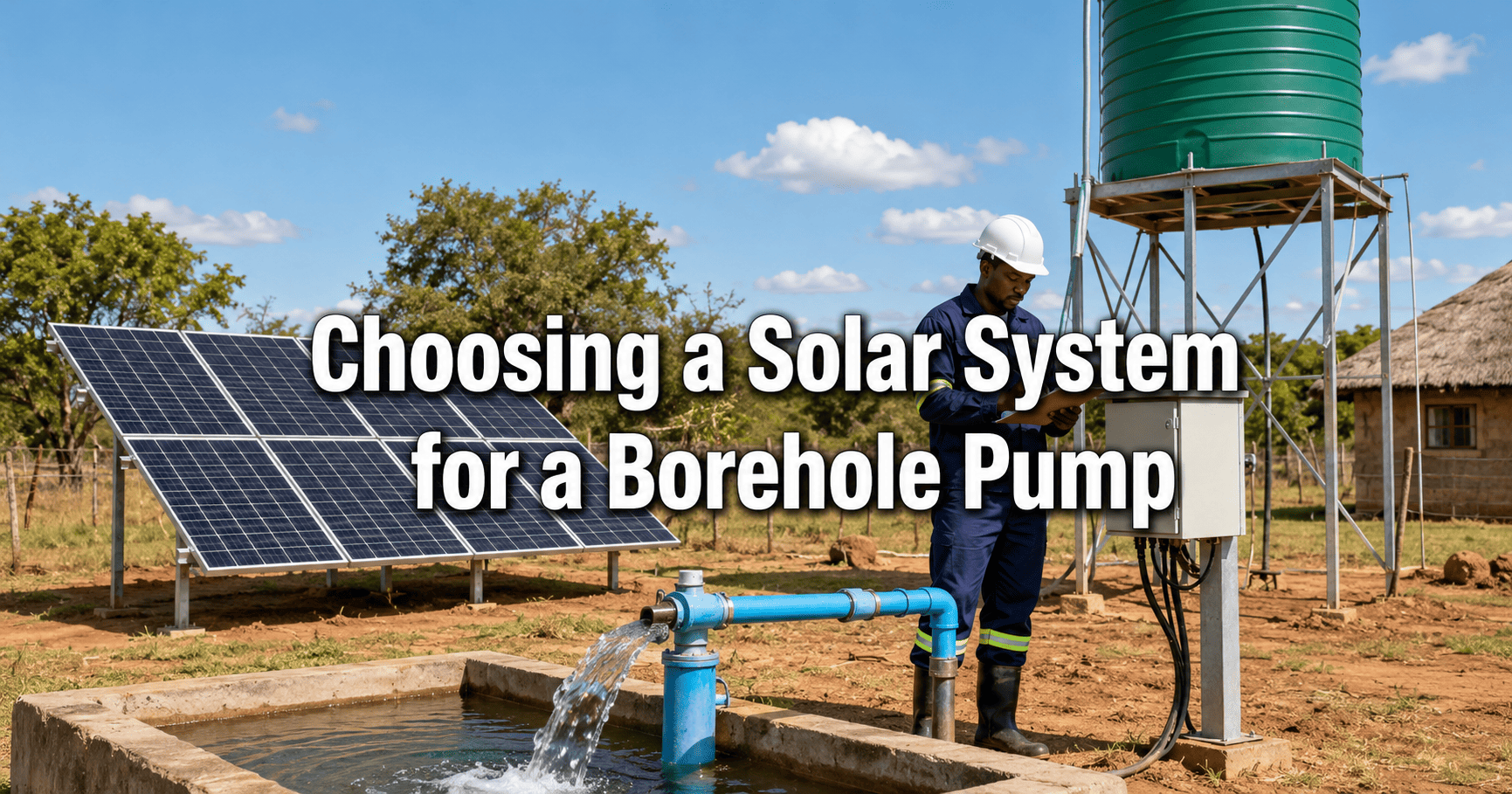
A solar-powered borehole can provide reliable water for a home, farm, livestock or business without depending entirely on ZESA or a generator. However, getting good results requires more than buying a pump and connecting it to several solar panels.
The pump, panels, controller, cabling, protection equipment, pipework and water storage must work as one correctly sized system.
A system that is too small may run but fail to deliver enough water. An oversized system may work, but it can add unnecessary expense. Incorrect voltage, poor protection or an unsuitable pump can also damage equipment and leave the property without water.
This guide explains how to choose a solar system for a borehole pump in Zimbabwe using the information that matters most.
Start with the amount of water you need
Before choosing the pump or panels, estimate how many litres of water the property needs each day.
Water may be required for:
- Household use
- Livestock
- Vegetable gardens
- Drip irrigation
- General crop irrigation
- Construction
- Commercial operations
- Filling a storage tank
- Supplying several homes
A household and a commercial farm can use the same size borehole but have completely different daily water requirements.
Your estimate should account for the busiest realistic day rather than only average consumption. It should also include reasonable allowance for future demand if the property is likely to expand.
For irrigation, consider the area being watered, crop requirements, irrigation method and seasonal conditions. Drip irrigation may require less water and pressure than sprinklers covering a large area.
Obtain reliable borehole information
The next step is collecting accurate information about the borehole.
Important measurements include:
- Total drilled depth
- Static water level
- Dynamic or pumping water level
- Sustainable borehole yield
- Borehole casing diameter
- Recommended pump installation depth
- Water quality, where relevant
Static water level
The static water level is the distance from ground level to the water when the pump is not operating.
Dynamic water level
The dynamic water level is the water level while pumping. It is normally lower than the static level because water is being removed from the borehole.
The dynamic level is particularly important when selecting the pump. A system designed using only the static level may perform poorly once pumping begins.
Borehole yield
The yield indicates how much water the borehole can sustainably provide, commonly expressed in litres per hour.
Installing a pump that removes water faster than the borehole can replenish it may cause the water level to fall until the pump runs dry. Dry-run protection can stop the pump before it is damaged, but it cannot increase the borehole’s yield.
A recent borehole-capacity test gives the installer much better information than estimating from the drilled depth alone.
Calculate the total dynamic head
The pump does not only lift water from inside the borehole. It may also need to push it uphill, raise it into a tank and overcome resistance through the pipe.
The total resistance is known as the total dynamic head.
It can include:
- The pumping water level in the borehole
- The vertical height from the borehole to the tank
- Additional elevation along the delivery route
- Pressure required by the irrigation or plumbing system
- Friction losses through pipes, bends, fittings and valves
For example, water may be drawn from a pumping level 45 metres below ground and delivered into a tank 10 metres above the borehole. The vertical lift is already approximately 55 metres before pipe friction and required outlet pressure are included.
A long, narrow pipe creates more resistance than a correctly sized pipe. Therefore, distance and pipe diameter affect the pump selection even where the ground appears relatively flat.
Do not choose the pump by horsepower alone
One of the most common mistakes is choosing a borehole pump using horsepower without checking its performance curve.
Two 1HP pumps can produce very different results. One may provide a higher flow at a low head, while another is designed to move less water against a much higher head.
Important pump specifications include:
- Rated power
- Operating voltage
- Maximum head
- Maximum flow
- Expected flow at the required head
- Outlet size
- Pump diameter
- Motor type
- Controller requirements
Maximum head and maximum flow should not be considered simultaneous performance figures.
At its maximum head, a pump may deliver little or no usable flow. Its maximum flow generally occurs when it is working against a much lower head.
The correct approach is to compare the required operating point with the manufacturer’s pump-performance curve.
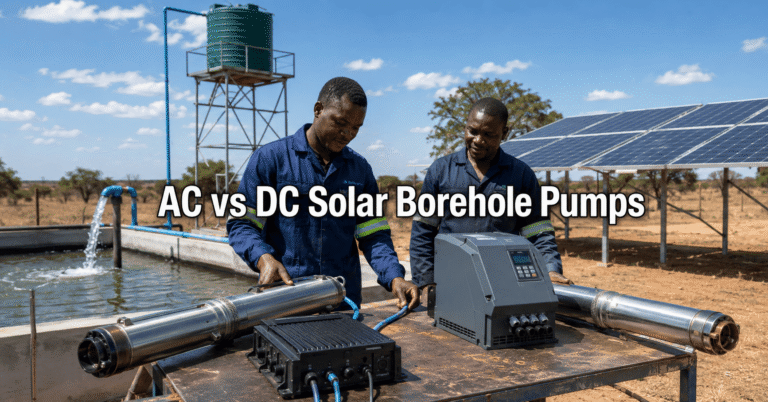
Choose between an AC and DC solar pump
Once the required flow and pumping head are known, you can consider whether an AC or DC pump is more appropriate.
A DC solar pump is commonly connected to panels through a dedicated pump controller. This arrangement can be efficient and relatively straightforward for solar-direct operation.
An AC pump requires a suitable solar pump inverter or variable-frequency drive to convert the panels’ DC electricity into AC electricity for the motor.
A DC system may suit:
- Remote off-grid properties
- Household water supply
- Livestock watering
- Smaller irrigation projects
- Solar-direct daytime pumping
- Systems that fill a storage tank
An AC system may suit:
- Higher water demand
- Deep or demanding boreholes
- Larger irrigation systems
- Existing compatible AC pumps
- Sites requiring ZESA or generator backup
- Commercial water-supply applications
Neither option is automatically better. The correct choice depends on the required duty point, available equipment, backup requirements and long-term access to replacement parts.
Read our detailed comparison of AC and DC solar borehole pumps before deciding between the two arrangements.
Match the panels to the pump controller
After selecting the pump and controller, the solar array must be designed around their electrical requirements.
Important specifications include:
- Required operating power
- Minimum starting voltage
- Maximum input voltage
- Recommended operating voltage
- Maximum input current
- Panel open-circuit voltage
- Panel operating voltage
- Panel operating current
- Temperature-related voltage changes
Solar panels may be wired in series to increase voltage or in parallel to increase current. The correct arrangement depends on the controller.
Connecting too few panels may prevent the pump from starting reliably or cause it to stop during weaker sunlight. Connecting too many panels in series can exceed the controller’s maximum voltage and damage it.
The number of panels should not be determined by dividing the pump’s wattage by the wattage printed on one panel. Real operating conditions, system losses, sunlight variation and the controller’s voltage range must also be considered.
Our guide to solar panels for boreholes in Zimbabwe explains these considerations in greater detail.
Should the solar array be oversized?
A carefully designed solar array may have more rated panel capacity than the pump motor’s headline power.
This does not necessarily mean the system is incorrectly oversized. Additional panel capacity can help:
- Start pumping earlier in the morning
- Continue operating later in the afternoon
- Improve performance under light cloud
- Compensate for heat and normal system losses
- Deliver the required daily water volume more reliably
However, the array must remain within the pump controller or solar pump inverter’s permitted electrical limits.
Adding panels without checking voltage and current is unsafe. The design must follow the specifications of the exact controller being installed.
Use water storage instead of batteries where practical
Most solar borehole-pumping systems do not need electrical batteries.
The pump can operate during daylight and transfer water into a storage tank. Water is then available at night or during periods of weaker sunlight.
This approach uses the tank to store water rather than storing electricity in batteries.
It can reduce:
- Initial system cost
- Battery replacements
- Energy-conversion losses
- Maintenance requirements
- System complexity
The storage tank should be sized according to daily demand, expected pumping hours and the level of reserve required during cloudy weather or maintenance.
A tank-full float switch can automatically stop the pump when the tank reaches the required level. This prevents overflow and unnecessary pump operation.
Where pumping must continue at night, a compatible generator, ZESA supply or battery system may be considered. The pump’s starting and running requirements must be included in the design.
Select the right tank position
The location and height of the tank affect both pump sizing and water pressure.
A higher tank increases the head against which the borehole pump must work. However, it can also provide more gravity pressure to the property after the water has been stored.
The designer should consider:
- Tank height above the borehole
- Distance between the borehole and tank
- Elevation changes along the route
- Required pressure at taps
- Irrigation pressure
- Structural strength of the tank stand
- Accessibility for maintenance
An extremely high tank stand should not be used as a substitute for a correctly designed pressure or booster-pump system.
The cost of the tank and supporting structure should also be included when budgeting for the complete water system.
Check the borehole casing and pump diameter
A pump must physically fit inside the borehole casing while allowing enough space for installation, cooling and removal.
The selected equipment should account for:
- Internal casing diameter
- Pump diameter
- Motor cooling requirements
- Submersible cable
- Delivery pipe
- Safety rope
- Water-level sensors
The pump must also be installed at the correct depth.
Placing it too high may expose it when the water level falls. Installing it too close to the bottom can increase the risk of drawing sediment into the pump.
The installer should follow the borehole report and the pump manufacturer’s installation instructions.
Use the correct delivery pipe
The delivery pipe affects water flow, system pressure and total dynamic head.
A pipe that is too narrow creates unnecessary friction. This forces the pump to work against additional resistance and can reduce the amount of water reaching the tank.
The pipe should be selected according to:
- Required flow rate
- Total length
- Pump outlet size
- Operating pressure
- Installation depth
- Exposure to sunlight
- Water quality
- Underground or above-ground installation
Fittings, non-return valves and bends must also be suitable for the expected pressure.
A cheaper undersized pipe can reduce the performance of an otherwise well-selected pumping system.
Install dry-run and tank-full protection
Dry running occurs when the pump operates without enough water around it. This can cause overheating and damage.
A suitable system may use:
- A borehole water-level probe
- A dry-run sensor
- Controller-based dry-run detection
- Automatic restart after water recovery
Tank-full protection is also important. A float switch tells the controller to stop pumping when the storage tank is full.
These controls help prevent pump damage, wasted water and unnecessary operation.
The controller and sensors must be compatible with each other and correctly configured during commissioning.
Include electrical protection
Solar borehole pumps operate outdoors and may be exposed to lightning, surges, moisture and unstable backup supplies.
Depending on the system, protection may include:
- DC fuses or circuit breakers
- DC isolators
- AC breakers
- Surge-protection devices
- Correct earthing
- Lightning protection
- Motor overload protection
- Overvoltage and undervoltage protection
- Weather-resistant controller housing
Long cables can increase exposure to induced surges during thunderstorms. Correct earthing and surge protection should therefore be treated as essential parts of the installation.
Learn how solar protection kits reduce damage from lightning, power surges and ZESA faults.
Use the correct cable sizes
Cable size affects voltage drop, pump performance and safety.
The installer must consider:
- Pump power
- Operating voltage
- Current
- Distance from panels to controller
- Distance from controller to pump
- Installation method
- Cable temperature rating
- Maximum acceptable voltage drop
A cable that is too small can cause energy loss, overheating and unreliable starting.
Submersible connections must be properly waterproofed. Ordinary electrical tape is not an acceptable long-term method for a cable joint that will remain underwater.
Decide whether backup power is necessary
A solar-direct pumping system operates when sufficient solar energy is available. This may be adequate where water is pumped into a suitably sized tank.
Backup power may be important for:
- Commercial farming
- High livestock demand
- Community water supplies
- Properties with limited storage
- Critical operations
- Pumping after sunset
Some AC solar pump inverters can accept power from solar panels, ZESA or a generator. Certain specialised DC systems also support alternative power through compatible equipment.
Backup compatibility should be confirmed before purchase. An AC supply must never be connected directly to a DC pump unless the system includes approved conversion equipment.
Consider seasonal conditions
A system should not be designed only around ideal midday sunshine.
Solar production changes with:
- Time of day
- Season
- Cloud cover
- Panel temperature
- Dust and dirt
- Panel orientation
- Shading
The required daily water volume must still be achievable during the relevant operating season.
For farming, water demand may be greatest during hot and dry periods. Fortunately, those periods may also provide strong solar conditions, but this relationship should not be assumed without considering the specific location and application.
The FAO notes that water availability, crop requirements, panels, pumps and irrigation infrastructure must be designed as one system.
Panels should also be cleaned when dust significantly reduces performance. Our guide explains how to maintain solar panels in Zimbabwe’s dusty climate.
Avoid shading on the solar panels
Even partial shading can reduce solar-array output.
Inspect the installation area for:
- Trees
- Buildings
- Water tanks
- Poles
- Antennas
- Future construction
- Seasonal changes in the sun’s path
The panels should face an appropriate direction, be mounted at a suitable angle and receive strong sunlight during the main pumping period.
The mounting structure must also withstand wind and protect the panels from theft or accidental damage.
Ground-mounted arrays are common for borehole-pumping systems because they can be installed near the pump equipment and positioned for good solar exposure. However, they must be securely mounted and protected from livestock, vehicles and unauthorised access.
Plan for maintenance and replacement parts
A reliable system should be serviceable after installation.
Ask the supplier:
- Is the pump brand supported locally?
- Is a replacement controller available?
- Are water-level and tank sensors replaceable?
- Can the pump be removed without damaging the pipe or cable?
- Is the controller’s manual available?
- Who can diagnose error codes?
- What does the warranty cover?
- Are commissioning settings documented?
A cheap system may become expensive if a failed controller cannot be replaced or if the entire pump must be changed because one component is unavailable.
Solar Power Shop supplies various water-pumping options, including solar DC pumps and complete water-pumping packages.
Common mistakes when choosing a borehole solar system
Choosing by horsepower only
Horsepower does not show how much water the pump will deliver at your required head.
Ignoring the dynamic water level
A pump selected using the static level may struggle when the water level falls during operation.
Buying panels before selecting the controller
The array voltage and current must match the controller’s permitted range.
Installing too little water storage
A small tank can leave the property without water at night even when the pump performs correctly during the day.
Using undersized cables
Long, thin cables create voltage loss and may prevent reliable pump operation.
Ignoring pipe friction
Narrow pipes and long delivery routes can substantially increase the system’s total head.
Excluding protection equipment
Saving money by omitting isolators, surge protection or earthing can expose expensive equipment to damage.
Buying before conducting a site assessment
A generic package may need different panels, cables, piping or controls once the borehole and property are assessed.
For additional examples, read about common Dongyin solar-pump installation mistakes and how to avoid them.
What should a complete quotation include?
A detailed quotation should identify:
- Pump make and model
- Pump power and voltage
- Expected flow at the required head
- Pump controller or solar pump inverter
- Number and rating of solar panels
- Panel configuration
- Mounting structure
- Electrical protection
- Water-level and tank sensors
- Submersible cable
- Delivery pipe and fittings
- Installation labour
- Transport or delivery
- Testing and commissioning
- Warranty information
- Items excluded from the quotation
Do not compare quotations using the final amount alone. Confirm whether they include the same equipment, materials, controls and installation work.
Solar Power Shop charges installation separately because labour and site-specific materials depend on the borehole and property. Delivery may also be charged depending on the location.
Our guide to solar installation costs in Zimbabwe explains why site conditions affect the final quotation.
Information to provide when requesting a quotation
To receive a useful recommendation, provide:
- Borehole location
- Total borehole depth
- Static water level
- Dynamic water level
- Tested borehole yield
- Borehole casing diameter
- Required litres per day
- Intended use of the water
- Distance from borehole to tank
- Tank height
- Pipe route and elevation changes
- Existing pump information, if applicable
- Availability of ZESA or a generator
- Whether pumping is required at night
- Any existing solar panels or pumping equipment
Photos of the borehole area, tank position and proposed solar-panel location can also assist with the initial assessment.
Frequently asked questions
How many solar panels are needed for a borehole pump?
The number depends on the pump’s power, operating voltage, controller limits, pumping head, daily water requirement and available sunlight. Horsepower alone is not enough to calculate the array.
Can a 1HP pump run directly from solar panels?
It can if it is designed for solar-direct operation or connected through a compatible controller or solar pump inverter. The correct voltage, current and protection requirements must be followed.
Does a solar borehole pump need batteries?
Not necessarily. Many systems pump into a water-storage tank during daylight, making water available after sunset without electrical batteries.
Can an existing borehole pump be converted to solar?
A suitable AC pump may sometimes be operated using a correctly sized solar pump inverter. Its motor specifications, condition, required head and starting requirements must first be assessed.
Can solar panels power both the house and borehole pump?
Yes, but the entire system must be designed for the combined loads. A dedicated solar-pumping array is often simpler and prevents household consumption from reducing water-pumping performance.
Is a DC pump better than an AC pump?
Not in every situation. DC pumps are often suitable for solar-direct systems, while AC pumps can offer a broader range and easier backup-power integration. The correct option depends on the borehole and water demand.
How large should the water tank be?
Tank size depends on daily consumption, pumping output, available solar hours and the amount of reserve required. It should be selected as part of the complete pumping-system design.
Can I install a solar borehole pump myself?
A simple packaged system may appear straightforward, but incorrect sizing, wiring, waterproofing or protection can damage the equipment. Professional assessment and installation are recommended, particularly for deep boreholes and higher-power systems.
Get a correctly sized borehole solar system
A reliable borehole solar system begins with accurate information—not a guess based on pump horsepower or the number of panels.
Solar Power Shop supplies borehole-pumping solutions for homes, farms, livestock and businesses throughout Zimbabwe. Customers can visit any Solar Power Shop branch or make an enquiry online.
Installation and site-specific materials are quoted separately. Delivery charges may apply depending on the location.
To receive a suitable recommendation, request a custom quotation and provide your borehole depth, water levels, tested yield, tank height, delivery distance and required daily water volume.