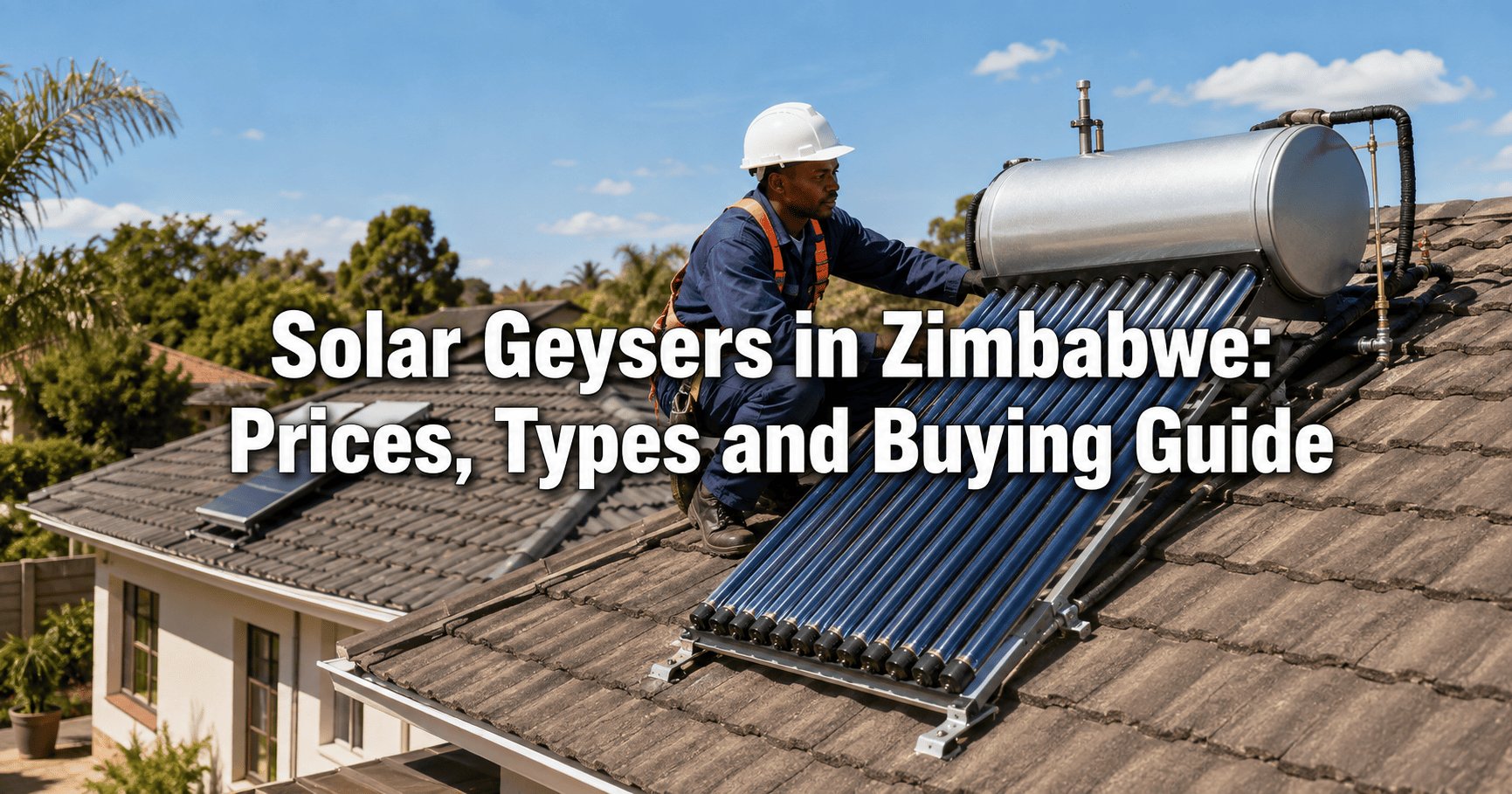
Solar Geysers in Zimbabwe: Prices, Types and Buying Guide
A solar geyser uses energy from the sun to heat water, reducing the amount of electricity required for bathing, washing and other household activities.
For Zimbabwean households dealing with rising electricity costs and periods of load shedding, a solar water heater can provide a practical way to improve hot-water availability without placing another heavy load on the home’s inverter and batteries.
However, solar geysers are not all the same.
Prices vary according to tank size, collector technology, pressure rating, manufacturing quality, backup-heating options and installation requirements. A system that works well on one property may be unsuitable for another property with different water pressure, roof construction or household demand.
This guide explains the prices, types and important buying considerations for solar geysers in Zimbabwe.
How much does a solar geyser cost in Zimbabwe?
At the time of writing, Solar Power Shop lists the following gravity solar geysers:
| Solar geyser | Listed equipment price |
|---|---|
| 100L Dongyin gravity solar geyser | US$350 |
| 200L Dongyin gravity/non-pressure solar geyser | US$450 |
These are listed product prices and may change as stock, exchange rates, supplier costs and product specifications change. Customers should confirm the current price and availability before ordering.
Installation is charged separately because the labour and additional materials depend on the property.
Delivery may also be charged depending on the customer’s location. Solar Power Shop supplies and installs systems throughout Zimbabwe, and customers may visit any branch or make an enquiry online.
What affects the price of a solar geyser?
The cost of a solar geyser is influenced by more than the storage capacity printed on the tank.
Important factors include:
- Tank capacity
- Pressurised or non-pressure design
- Collector type
- Tank and frame materials
- Insulation quality
- Number and quality of evacuated tubes
- Electric backup element
- Controller and sensors
- Roof-mounting requirements
- Plumbing modifications
- Distance from the geyser to bathrooms
- Water pressure
- Delivery location
- Installation labour
- Warranty and spare-part support
Two solar geysers with the same tank capacity may have different prices because they are designed for different operating pressures or use components of different quality.
How does a solar geyser work?
A solar geyser captures heat from sunlight and transfers it to water.
In a common thermosiphon system, cold water moves into solar collector tubes or a collector panel. The sun heats the water, causing it to rise naturally into the insulated storage tank. Cooler water then moves down towards the collector and the cycle continues.
This natural circulation occurs without an electric circulation pump.
The International Energy Agency’s Solar Heating and Cooling Programme describes thermosiphon systems as passive solar water heaters that use natural convection to circulate water.
During sunny weather, a properly selected system can heat and store water for later use. The insulated tank helps retain that heat into the evening and early morning.
Actual water temperature depends on:
- Available sunlight
- Time of day
- Season
- Collector orientation
- Hot-water usage
- Tank insulation
- System size
- Water entering the tank
- Collector condition
Main types of solar geysers in Zimbabwe
Solar geysers can be grouped according to pressure rating, collector technology and circulation method.
Gravity or non-pressure solar geysers
A gravity solar geyser is designed to operate without high mains-water pressure.
The storage tank is normally positioned above the collector. Water flows from the tank to the taps mainly through gravity.
These systems are also called:
- Non-pressure solar geysers
- Low-pressure solar geysers
- Gravity-fed solar water heaters
- Passive thermosiphon systems
Advantages of gravity solar geysers
- Lower initial purchase price
- Relatively simple construction
- No circulation pump required
- Low electricity dependence
- Suitable for properties using elevated water tanks
- Straightforward daytime water heating
- Fewer electronic components
Limitations of gravity systems
- Hot-water pressure may be lower
- They are unsuitable for direct high-pressure supply unless specifically designed for it
- The roof must support the collector and a full water tank
- Installation position affects water flow
- They may not work well with certain high-pressure mixers and shower systems
- The exposed tank can affect the appearance of the roof
A 100-litre tank weighs considerably more when full than when empty. The roof structure must therefore be inspected before installation.
Pressurised solar geysers
A pressurised solar geyser is designed to operate within a pressurised plumbing system.
It can provide stronger and more consistent hot-water pressure than a basic gravity system, provided the incoming water supply and plumbing are correctly designed.
Pressurised systems may be appropriate for:
- Homes supplied by a pressure pump
- Properties connected to pressurised municipal water
- Multi-bathroom houses
- Modern mixer taps and showers
- Users who prefer stronger shower pressure
Advantages of pressurised systems
- Better hot-water pressure
- Improved compatibility with modern plumbing
- Can serve several outlets when correctly sized
- May provide more installation flexibility
Limitations of pressurised systems
- Higher purchase price
- More demanding installation
- Requires suitable pressure-control and safety components
- Repairs may be more expensive
- Incorrect pressure can damage the system
- Professional plumbing is particularly important
A system should never be connected to a high-pressure water supply unless its tank, valves and fittings are rated for that pressure.
Evacuated-tube solar geysers
Evacuated-tube collectors use rows of glass tubes to absorb solar heat.
Each tube contains an insulated vacuum layer that reduces heat loss. This allows the collector to heat water effectively under a wide range of conditions.
Evacuated tubes are commonly used on gravity and thermosiphon solar geysers sold in Zimbabwe.
Advantages of evacuated tubes
- Good solar-heat collection
- Reduced heat loss from the collector
- Individual damaged tubes may be replaceable
- Commonly available in domestic system sizes
- Effective during cooler conditions when properly installed
Limitations of evacuated tubes
- Glass tubes can break through impact or poor handling
- Replacement tubes must match the system
- Hard-water deposits may affect some direct-flow designs
- Exposed tubes require care during installation and maintenance
- Systems can overheat when hot water is not used for extended periods
The tubes should be inspected occasionally for cracks, lost vacuum or visible damage.
Flat-plate solar collectors
A flat-plate collector normally consists of a dark absorber surface inside an insulated and glazed rectangular enclosure.
Water or a heat-transfer fluid passes through pipes connected to the collector and absorbs the heat.
Advantages of flat-plate collectors
- Strong, neat rectangular construction
- Fewer exposed glass tubes
- Suitable for pressurised and indirect systems
- Commonly used in professionally engineered installations
Limitations of flat-plate collectors
- May have a higher initial price
- The complete panel may require repair if damaged
- Performance depends on collector quality and installation
- Some systems require pumps, controllers or additional plumbing
Collector type should be considered together with water quality, pressure, maintenance and installation requirements rather than being selected by appearance alone.
Direct and indirect solar geysers
In a direct system, the household water itself circulates through the collector.
In an indirect system, a separate heat-transfer fluid circulates through the collector and passes heat to the household water through a heat exchanger.
Direct systems are generally simpler. Indirect systems can provide additional protection in conditions involving freezing or challenging water quality, but they are more complex.
The United States Department of Energy notes that water temperature, system size, freezing risk, hard-water scaling and maintenance needs are important when selecting a solar water-heating system.
For most buyers, the practical question is whether the system being considered is suitable for the property’s water quality and local winter conditions.
Active and passive systems
A passive solar geyser circulates water using natural convection without an electric pump. Thermosiphon gravity geysers fall into this category.
An active system uses a circulation pump and controller to move water or heat-transfer fluid between the collector and storage tank.
Passive systems
Passive systems are generally:
- Simpler
- Less expensive
- Easier to maintain
- Less dependent on electricity
Active systems
Active systems may offer:
- Greater control
- Flexible collector and tank placement
- Compatibility with larger installations
- More advanced temperature management
However, they also introduce pumps, controllers and additional maintenance requirements.
For many Zimbabwean homes, a passive thermosiphon system is attractive because of its simplicity. Larger homes, lodges and commercial properties may benefit from a more advanced engineered system.
What solar-geyser size do you need?
Solar geysers are commonly described by their storage capacity in litres.
Typical domestic sizes include:
- 100 litres
- 150 litres
- 200 litres
- 250 litres
- 300 litres
The correct capacity depends on:
- Number of people in the household
- Number of bathrooms
- Showering habits
- Bath usage
- Laundry requirements
- Daily hot-water consumption
- Availability of backup heating
- Expected cloudy-weather reserve
A small household may find a 100-litre system adequate, while a larger family may require 200 litres or more.
However, household size alone does not provide a perfect answer. Two families with the same number of people may consume very different amounts of hot water.
General solar-geyser sizing guide
The following table is only a starting point:
| Household size | Possible starting capacity |
|---|---|
| 1–2 people | 100 litres |
| 2–4 people | 150 litres |
| 3–5 people | 200 litres |
| 5 or more people | 250–300 litres or a professionally sized system |
Actual requirements depend on hot-water habits and the system’s ability to recover heat during the day.
Choosing a tank that is too small may cause the household to run out of hot water. Choosing one that is unnecessarily large can increase the purchase price, roof load and heating time.
Does a solar geyser work during cloudy weather?
Yes, but the water may not become as hot as it would during strong sunshine.
Evacuated tubes and flat-plate collectors can still absorb solar radiation when conditions are not perfectly clear. However, output falls when solar energy is limited.
Performance during cloudy weather depends on:
- Collector technology
- Collector area
- Tank capacity
- Insulation
- Existing water temperature
- Hot-water usage
- Duration of the cloudy period
A system with a correctly sized tank can store hot water produced during sunnier hours for later use.
Homes that require guaranteed hot water may choose a system with an electric backup element or retain another backup-heating method.
Does a solar geyser need electricity?
A basic passive solar geyser does not require electricity to collect solar heat or circulate the water.
Electricity may still be used for:
- A backup heating element
- An active circulation pump
- A digital controller
- Freeze protection
- Timers or temperature controls
A solar geyser with an electric element is not completely independent of electricity when the element is in use. Nevertheless, solar heating can reduce how frequently the element is needed.
Do not assume that a standard household solar system can operate the electric backup element without checking its power rating. Heating elements are heavy electrical loads.
Read our guide to what a 5kVA solar system can run in Zimbabwe before adding large heating loads to an inverter system.
Non-pressure or pressure solar geyser: which should you choose?
A gravity or non-pressure geyser may be suitable when:
- The property uses an elevated water tank
- Lower hot-water pressure is acceptable
- The budget is limited
- A simple passive system is preferred
- The plumbing is compatible with gravity-fed water
A pressurised geyser may be the better option when:
- Stronger shower pressure is required
- The property uses a pressure pump
- Modern mixer taps are installed
- Several bathrooms require hot water
- The household wants performance similar to a conventional pressurised geyser
Do not buy a non-pressure system and connect it directly to a pressure pump without suitable professional design. Excessive pressure can damage the tank and create a serious safety risk.
Check your water supply before buying
The installer needs to understand how water reaches the property.
Possible water sources include:
- Municipal supply
- Borehole with a pressure pump
- Borehole feeding an elevated tank
- Rainwater-storage tank
- Combination of several sources
The water-supply arrangement affects:
- Required geyser pressure rating
- Valve selection
- Cold-water feed
- Hot-water delivery pressure
- Tank positioning
- Need for a pressure-reducing valve
- Compatibility with existing taps
If the home uses a borehole, also consider water hardness and mineral content. Scale can reduce flow and heat-transfer performance over time.
Water quality and mineral scale
Hard water contains dissolved minerals that may form scale inside pipes, tanks, valves and collectors.
The risk depends on:
- Local water chemistry
- Operating temperature
- System design
- Maintenance frequency
- Materials used in the geyser
Possible signs of scale include:
- Reduced hot-water flow
- Longer heating times
- Blocked tubes or pipes
- Noisy backup elements
- Valve problems
Ask the installer whether the selected system is appropriate for the water quality and whether periodic descaling is recommended.
Where borehole water contains significant minerals, a water test may help guide the decision.
Can a solar geyser overheat?
Yes. Solar water heaters can become very hot during strong sunshine, particularly when little hot water is being used.
Potential concerns include:
- Scalding water
- Excessive tank pressure
- Steam formation
- Damage to unsuitable fittings
- Stress on seals and valves
A properly designed system may require:
- Temperature-and-pressure relief valve
- Mixing or tempering valve
- Expansion provision
- Correctly rated pipes and fittings
- Safe overflow or discharge route
- Suitable controller settings
A mixing valve blends hot and cold water to reduce the temperature delivered to taps. This can help protect users from scalding.
The IEA Solar Heating and Cooling Programme identifies overheating during periods without hot-water use as an important durability consideration for some thermosiphon systems.
Consider winter and frost conditions
Zimbabwe has a generally sunny climate, but some areas experience low overnight winter temperatures.
Water freezing inside exposed tubes or pipes can damage components. The level of risk depends on:
- Property location
- Local minimum temperatures
- Collector design
- Pipe insulation
- Direct or indirect circulation
- Installation method
Buyers in colder areas should ask specifically about frost protection and warranty conditions.
External hot-water pipes should also be insulated to reduce heat loss and protect them from environmental exposure.
Is your roof suitable?
A roof-mounted geyser adds considerable weight.
The roof may need to support:
- The empty geyser
- The full water tank
- Collector tubes or panels
- Mounting frame
- Wind loads
- Maintenance personnel
Before installation, check:
- Roof age and condition
- Truss strength
- Roofing material
- Mounting position
- Solar exposure
- Shading
- Safe maintenance access
- Distance to hot-water outlets
The installer should not mount a heavy geyser on a damaged or structurally unsuitable roof.
If roof reinforcement or major mounting work is required, this will increase the installation cost.
Position and orientation matter
The collector should receive strong sunlight during the main heating period.
Avoid shading from:
- Trees
- Chimneys
- Water tanks
- Nearby buildings
- Satellite dishes
- Future construction
The orientation and tilt should suit the property’s location and roof design. Poor positioning can reduce water-heating performance even when the geyser itself is good quality.
Long pipe runs between the geyser and bathrooms also waste water and allow heat to escape. Where practical, the system should be positioned near the main hot-water outlets.
What does installation normally involve?
A solar-geyser installation may include:
- Transporting the system to the property
- Roof inspection
- Mounting the collector and tank
- Installing support brackets
- Connecting the cold-water supply
- Connecting hot-water pipes
- Installing valves and safety equipment
- Insulating exposed pipework
- Plumbing modifications
- Connecting a backup element
- Testing for leaks
- Checking water pressure
- Commissioning the system
The exact work depends on the property.
Installation is charged separately from the listed Solar Power Shop equipment prices. Customers should request a quotation covering labour and any additional materials required at the site.
Our guide to solar installation costs in Zimbabwe explains why installation prices vary between properties.
Costs that may not be included in the geyser price
Before comparing quotations, check whether they include:
- Installation labour
- Delivery
- Roof reinforcement
- Additional pipework
- Pipe insulation
- Pressure-reducing valve
- Mixing valve
- Non-return valve
- Temperature-and-pressure relief valve
- Electrical cable for backup heating
- Electrical isolator and breaker
- Plumbing alterations
- Scaffolding or special roof access
- Removal of an old geyser
- Testing and commissioning
A cheaper product quotation may become more expensive once essential installation materials are added.
Request an itemised quotation so that you understand what is included.
Solar geyser or solar panels with an electric geyser?
These are different approaches.
A solar thermal geyser uses sunlight to heat water directly through collector tubes or panels.
A photovoltaic system converts sunlight into electricity, which could then operate an electric geyser element.
Direct solar water heating can be an efficient way to use roof space because the sunlight is converted directly into heat. However, photovoltaic panels are more flexible because their electricity can power different appliances.
Operating a conventional geyser element from an inverter system may require:
- A sufficiently powerful inverter
- Enough solar-panel capacity
- Adequate battery capacity if used after sunset
- Smart load scheduling
- Correct electrical protection
For homes mainly concerned with hot water, a dedicated solar geyser may reduce pressure on the household’s inverter and battery bank.
For homes with a large existing solar-electric system, scheduled electric water heating may be another option. The complete energy requirement should be assessed before choosing.
Solar geyser or gas geyser?
A solar geyser uses freely available sunlight but has a higher initial installation cost and depends on solar conditions.
A gas geyser can heat water on demand but requires a continuing gas supply and safe ventilation.
Some households combine solar heating with an alternative backup method. The best arrangement depends on:
- Daily hot-water use
- Budget
- Property layout
- Gas availability
- Electrical backup
- Desired water pressure
- Maintenance preferences
A solar geyser may provide lower ongoing energy costs, while a gas unit can offer reliable on-demand backup during extended cloudy weather.
How to compare solar-geyser quotations
When comparing systems, ask each supplier to specify:
- Tank capacity
- Pressurised or non-pressure design
- Collector type
- Number of evacuated tubes or collector area
- Tank material
- Insulation type
- Frame material
- Maximum operating pressure
- Backup element rating
- Included valves and controls
- Warranty period
- Installation cost
- Additional materials
- Delivery cost
- Availability of replacement tubes and parts
Avoid comparing two systems using tank capacity and price alone.
A better-quality tank, thicker insulation, suitable safety valves and dependable local support may justify a higher price.
Common mistakes when buying a solar geyser
Buying the wrong pressure type
A non-pressure geyser should not be installed on a high-pressure supply without an appropriate design.
Choosing a tank that is too small
The household may run out of hot water before everyone has bathed.
Ignoring the roof structure
A full tank places significant weight on the roof.
Focusing only on purchase price
Installation, plumbing, safety valves and long-term parts availability matter.
Installing the collector in shade
A shaded collector cannot deliver its expected performance.
Using unsuitable pipes
Hot-water pipes and fittings must withstand the system’s temperature and pressure.
Omitting safety valves
Pressure and temperature controls are essential parts of a safe installation.
Failing to insulate pipes
Uninsulated external pipes lose heat before the water reaches the bathroom.
Assuming the product price includes installation
Equipment and installation are priced separately unless the quotation specifically says otherwise.
Solar-geyser maintenance
A solar geyser should be inspected periodically.
Maintenance may include:
- Checking for water leaks
- Inspecting evacuated tubes
- Cleaning dusty collector surfaces
- Checking the mounting frame
- Inspecting roof penetrations
- Testing safety valves
- Checking pipe insulation
- Removing mineral scale where required
- Inspecting the electric backup element
- Confirming controller and sensor operation
- Checking for corrosion
Do not climb onto a roof without the correct safety equipment. Roof-mounted systems should be inspected by a qualified technician.
Frequently asked questions
How much is a 100-litre solar geyser in Zimbabwe?
Solar Power Shop currently lists its 100L Dongyin gravity solar geyser at US$350. Installation, extra materials and possible delivery charges are separate. Confirm the price and availability before ordering.
How much is a 200-litre solar geyser in Zimbabwe?
Solar Power Shop currently lists its 200L Dongyin gravity/non-pressure solar geyser at US$450. Installation and site-specific materials are quoted separately.
Is a 100-litre solar geyser enough for a family?
It may suit a small household, but adequacy depends on the number of users and their hot-water habits. A larger family may require a 150L, 200L or larger system.
Does a solar geyser work at night?
The collector does not produce heat without sunlight, but the insulated tank stores hot water heated during the day for use at night.
Can a solar geyser work during load shedding?
A passive solar geyser can continue heating water from sunlight without ZESA. An electric backup element will not operate during load shedding unless it has another suitable power source.
Can a pressure pump supply a gravity solar geyser?
It should not be connected directly unless the installation includes suitable pressure regulation and the manufacturer permits it. Excessive pressure can damage a non-pressure tank.
Can a solar geyser provide very hot water?
Yes. Water can become extremely hot during strong sunshine. Correct safety valves and temperature-control measures are important.
Is installation included in the listed price?
No. Installation is quoted separately because every property has different roofing, plumbing and material requirements.
Does Solar Power Shop install solar geysers outside Harare?
Solar Power Shop serves customers throughout Zimbabwe. Delivery and installation costs may depend on the location.
Choosing the right solar geyser
A suitable solar geyser should match:
- Household hot-water demand
- Water-supply pressure
- Plumbing system
- Roof strength
- Available sunlight
- Local winter conditions
- Water quality
- Backup-heating requirements
- Budget
- Maintenance expectations
For a gravity-fed home with modest hot-water demand, a simple non-pressure thermosiphon system may offer good value.
For a larger home with pressure pumps, modern showers and several bathrooms, a pressurised or professionally designed system may be more appropriate.
The safest approach is to assess the property before purchasing the equipment.
Request a solar-geyser quotation
Solar Power Shop supplies solar geysers and related solar-energy equipment to customers throughout Zimbabwe.
Customers can visit any Solar Power Shop branch or enquire online. Installation and site-specific materials are quoted separately, while delivery charges may apply depending on the location.
Browse the available solar geysers or request a custom quotation for advice on capacity, water pressure, installation requirements and current availability.