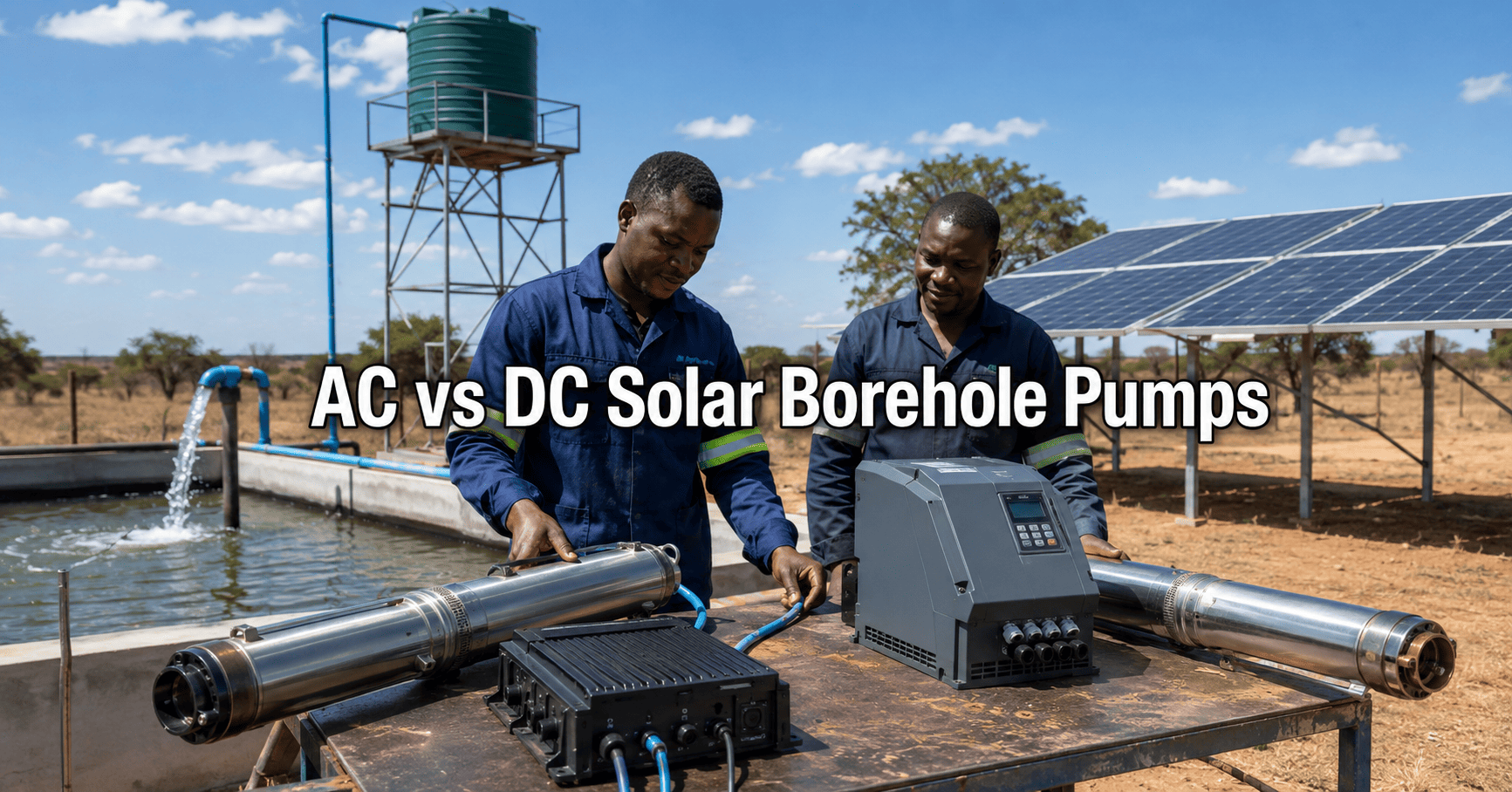
AC vs DC Solar Borehole Pumps
A solar borehole pump can provide water for a home, livestock, irrigation or business without depending entirely on ZESA. However, choosing the right pumping system involves more than selecting a pump according to its horsepower.
One of the first decisions is whether to install an AC or DC solar borehole pump.
DC pumps are commonly associated with smaller solar-direct systems, while AC pumps are often selected for deeper boreholes and applications requiring more water. However, this is only a general distinction. Modern controllers and hybrid pumping systems have made both options considerably more flexible.
The best choice depends on your borehole depth, water level, required daily water volume, pumping head, pipe length, storage capacity and access to backup electricity.
This guide compares AC and DC solar borehole pumps to help homeowners, farmers and businesses in Zimbabwe make a more informed decision.
What is a DC solar borehole pump?
A DC solar borehole pump uses direct-current electricity. In a typical solar-direct installation, the solar panels send DC electricity to a pump controller, which regulates the power supplied to the pump.
A basic DC solar-pumping system consists of:
Solar panels → pump controller → DC borehole pump → storage tank
A suitable controller may provide functions such as:
- Maximum Power Point Tracking
- Soft starting
- Dry-run protection
- Overvoltage protection
- Undervoltage protection
- Tank-full control
- Borehole water-level monitoring
Many modern DC solar pumps use brushless motors. Unlike older brushed motors, they do not contain brushes that gradually wear down through normal operation.
Because solar panels already produce DC electricity, a dedicated DC system can operate without first converting the electricity to AC. This can produce a simple and efficient pumping arrangement when the components are correctly matched.
Solar Power Shop supplies solar water-pumping kits for different household, agricultural and commercial requirements.
What is an AC solar borehole pump?
An AC borehole pump uses alternating-current electricity—the general type of electricity supplied by ZESA and conventional generators.
Solar panels produce DC electricity. Therefore, when an AC pump is powered from solar panels, the installation normally requires a solar pump inverter or variable-frequency drive.
The typical arrangement is:
Solar panels → solar pump inverter or VFD → AC borehole pump → storage tank
The solar pump inverter converts electricity from DC to AC and regulates the pump according to the solar power available. Depending on the model, it may also provide dry-run protection, motor protection and connections for water-level or tank sensors.
Some solar pump inverters can accept an additional AC supply from ZESA or a generator. This can allow the pump to continue operating when solar production is insufficient.
AC solar pumping systems are frequently considered for:
- Deep boreholes
- High pumping heads
- Large daily water requirements
- Commercial farms
- Irrigation schemes
- Community water supplies
- Existing AC pumps being converted to solar
A solar pump inverter is not necessarily the same as an ordinary household inverter. It is specifically designed to start, regulate and protect an electric pump motor.
AC vs DC solar borehole pumps at a glance
| Consideration | DC solar pump | AC solar pump |
|---|---|---|
| Electricity supplied to pump | Direct current | Alternating current |
| Main control equipment | DC pump controller | Solar pump inverter or VFD |
| Solar-direct operation | Relatively straightforward | Requires DC-to-AC conversion |
| Common applications | Homes, livestock and small-to-medium systems | Larger systems, deeper lifts and higher water demand |
| Efficiency at smaller sizes | Often very good | Depends on pump and inverter matching |
| Pump availability | More specialised | Broad range of conventional pump sizes |
| ZESA or generator backup | Requires compatible hybrid equipment | Often easier with a suitable pump inverter |
| Existing pump conversion | Usually requires changing the pump | A suitable existing AC pump may sometimes be retained |
| Repairs and replacements | Some parts may be brand-specific | AC pump components may be more widely available |
| System design | Must be sized for the borehole | Must be sized for the borehole |
These are general tendencies rather than fixed rules. A correctly designed AC system can outperform a poorly selected DC system. Similarly, a suitable DC pump can be a better investment than an oversized AC installation.
Which type is more efficient?
DC solar pumps are often described as more efficient because solar panels generate DC electricity. A solar-direct DC system avoids the separate DC-to-AC conversion required to operate a conventional AC motor.
Brushless DC motors can also perform efficiently as the amount of sunlight changes during the day.
However, efficiency should not be judged using the letters “AC” or “DC” alone. The performance of the entire system depends on:
- Motor efficiency
- Pump hydraulics
- Controller or inverter efficiency
- Solar-array size
- Borehole depth
- Dynamic water level
- Pipe diameter
- Friction losses
- Required flow rate
A high-quality AC pump connected to a correctly selected solar pump inverter can perform very well. A DC pump can still produce disappointing results if it is not capable of supplying the required flow at the borehole’s total pumping head.
Some specialised pumps can even accept both power types. For example, Grundfos explains that some renewable-energy submersible pumps can operate using either AC or DC power.
The specifications and pump-performance curve are therefore more important than the AC or DC label by itself.
Which pump is better for a deep borehole?
Neither pump type should be chosen using borehole depth alone.
The installer must calculate the total dynamic head. This is the total resistance the pump must overcome while delivering the water and can include:
- The pumping water level inside the borehole
- The vertical rise from the borehole to the storage tank
- The pressure required at the delivery point
- Friction losses through pipes, bends and valves
The drilled depth of a borehole is not necessarily its pumping head.
For example, a borehole may be 80 metres deep while its normal water level is much closer to the surface. However, the water level may fall while the pump is running, increasing the actual lift.
AC pumps are available in a wide range of powerful models, so they are often selected for deep boreholes and high-volume applications. Nevertheless, specialised DC solar pumps can also deliver water from considerable depths when correctly selected.
Ask the supplier to confirm the proposed pump’s expected flow rate at your calculated total head. Do not rely only on the pump’s maximum head or maximum flow because those figures normally occur under different operating conditions.
Which pump is better for farming and irrigation?
The answer depends on the size and nature of the agricultural operation.
A DC solar pump may be suitable for:
- Livestock watering
- Small gardens
- Drip-irrigation systems
- Filling a storage tank
- Remote sites without ZESA
- Moderate daily water requirements
An AC solar-pumping system may be more appropriate for:
- Larger irrigation areas
- High-volume water transfer
- Pressure-dependent irrigation
- Deep boreholes with demanding pumping heads
- Farms that already have a suitable AC pump
- Sites requiring generator or ZESA backup
Solar pumping works particularly well when water is pumped into a tank or reservoir during daylight hours. The stored water can then be used when required, reducing the need for electrical batteries.
The Food and Agriculture Organization’s overview of solar-powered irrigation explains that a complete installation includes the solar array, controller, pump and water-distribution or storage infrastructure.
This is why buyers should plan the entire water-delivery system rather than concentrating only on the pump.
Do solar borehole pumps need batteries?
Solar borehole pumps do not necessarily require batteries.
In many installations, the panels operate the pump during the day and the water is stored in an elevated tank. The tank stores the useful result—water—instead of using batteries to store electricity.
This approach can reduce:
- Battery costs
- Future battery replacements
- Energy-conversion losses
- Maintenance requirements
- Overall system complexity
A sufficiently large storage tank can provide water at night or during periods of weak sunlight.
Battery storage may be considered where water must be pumped outside daylight hours and adequate water storage is not possible. However, the starting and running requirements of the pump must be included when sizing the inverter and battery bank.
For many solar-direct borehole systems, increasing water-storage capacity is more practical than installing batteries solely to operate the pump after sunset.
What happens on cloudy days?
The output of a solar-direct pump changes according to the available sunlight.
A suitable controller or solar pump inverter allows the pump to begin operating when enough solar energy becomes available. Water flow may increase towards midday and decrease when solar radiation falls.
The FAO’s guidance on solar-powered water lifting notes that the flow rate and daily water volume of a solar-direct system vary with solar radiation.
This makes it important to size the solar array and storage tank for the required daily water volume, including expected seasonal changes.
Adding more panels may extend the useful pumping period, but additional panels must remain within the controller’s permitted voltage and current limits.
For more information, read our guide explaining how solar panels perform on cloudy days.
Can an AC pump use ZESA or generator backup?
Yes, provided that the system is designed for it.
Some solar pump inverters accept both solar input and an AC supply from ZESA or a generator. Depending on the equipment, the alternative supply may be selected manually, switched automatically or combined with the solar supply.
This flexibility is one reason an AC system may be attractive for farms and businesses where water availability cannot depend entirely on daytime solar production.
DC pump systems can also support alternative power, but they require compatible conversion or hybrid control equipment. An AC electricity supply must never be connected directly to a DC pump.
Manufacturers use different approaches. For example, LORENTZ offers hybrid solar-pumping equipment that manages solar and AC inputs.
Always confirm the controller’s exact capabilities before buying the pump.
Advantages of a DC solar borehole pump
Efficient solar-direct operation
The system is specifically designed to use the DC electricity produced by solar panels.
Suitable for remote locations
A DC pump can work in an area without ZESA, making it useful for rural homes, livestock watering and off-grid farms.
Relatively simple system design
A basic system may require only panels, a controller, protection equipment and the pump. It does not necessarily need a household inverter or battery bank.
Good performance under changing sunlight
A properly matched controller can regulate pump operation as solar production changes throughout the day.
Low operating costs
Once installed, the pump uses solar energy instead of purchased fuel or grid electricity during normal daytime operation.
Solar Power Shop stocks different pumping options, including 2HP solar DC pumps. The correct model must still be selected using the borehole data and required daily water volume.
Limitations of a DC solar pump
Potential disadvantages include:
- Replacement controllers may be model-specific
- Not every pump supports ZESA or generator power
- The available range can be narrower at higher power ratings
- The technician must understand the particular controller
- Incorrect solar-panel voltage can damage the controller
- Some inexpensive pumps have limited documentation or spare-part support
Before purchasing a system, ask whether replacement controllers, sensors and pump components are locally available.
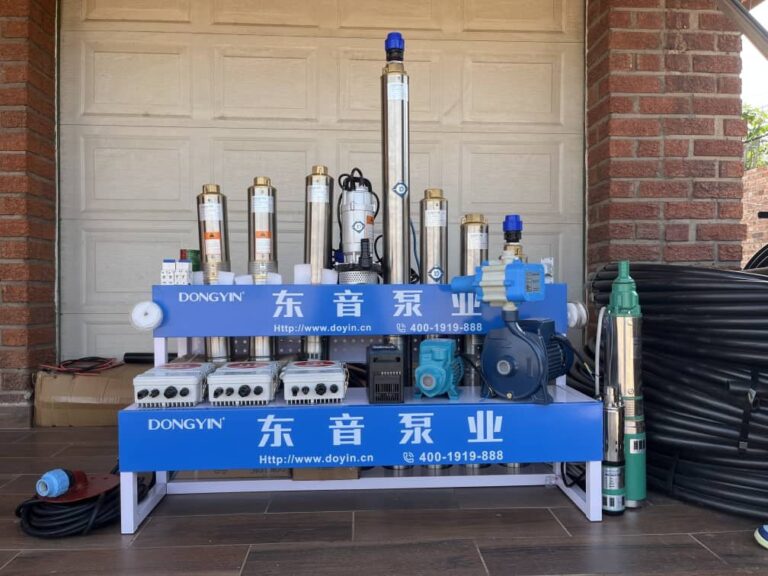
Our guide to common Dongyin solar-pump installation mistakes explains problems that can occur when the pump, controller, cabling or protection equipment is incorrectly selected.
Advantages of an AC solar borehole pump
Wider selection of pumps
AC borehole pumps are available across a broad range of power, flow and pumping-head requirements.
Easier integration with backup power
A suitable installation can often operate from solar energy together with ZESA or a generator.
Possible reuse of an existing pump
Where a borehole already has a compatible and serviceable AC pump, it may be possible to add a solar pump inverter and panels without replacing the pump.
The motor specifications and condition must be checked before deciding whether this is practical.
Suitable for larger applications
The wide range of equipment can make AC pumping systems suitable for commercial water supplies, demanding boreholes and larger irrigation projects.
Familiarity among technicians
Conventional AC pumps may be more familiar to general pump technicians, although the solar pump inverter still requires specialist installation and configuration.
Limitations of an AC solar pump
Possible drawbacks include:
- A solar pump inverter or VFD is required
- DC-to-AC conversion introduces some energy loss
- Motor-starting requirements must be carefully managed
- Incorrect inverter settings can cause unreliable operation
- Some applications may require a larger solar array
- Additional components can increase installation complexity
An ordinary inverter should not be selected merely because its advertised power rating is higher than the pump’s rating. Pump motors can have significant starting requirements, and the inverter must be suitable for motor control.
Do not choose a pump by horsepower alone
A 1HP pump is not automatically suitable for every borehole that previously used another 1HP pump.
Two pumps with identical motor ratings can have very different:
- Maximum pumping heads
- Flow rates
- Impeller designs
- Efficiency curves
- Outlet sizes
- Voltage requirements
- Controller requirements
A correct recommendation begins with the required daily water volume and total dynamic head. The pump-performance curve can then show whether a particular model will provide the necessary flow under those conditions.
Choosing only by horsepower may result in a pump that operates but delivers too little water. It may also lead to an unnecessarily expensive and oversized installation.
Information needed before selecting a pump
Provide the installer or supplier with:
- Total borehole depth
- Static water level
- Pumping or dynamic water level
- Tested borehole yield
- Distance from the borehole to the tank
- Tank height above ground
- Required litres of water per day
- Pipe diameter and approximate route
- Intended use of the water
- Required pressure at the delivery point
- Availability of ZESA or a generator
- Whether pumping is required after sunset
A recent borehole-capacity or yield test is extremely valuable. Without reliable borehole information, pump selection becomes guesswork.
Our guide to solar panels for boreholes in Zimbabwe provides more information about matching the panels to the pumping equipment.
Installation and protection requirements
Both AC and DC solar borehole pumps need correct installation and electrical protection.
Depending on the system, the installation may require:
- DC isolators
- Fuses or circuit breakers
- Surge-protection devices
- Proper earthing
- Lightning protection
- Correctly sized submersible cable
- Waterproof cable joints
- Dry-run protection
- Borehole water-level sensors
- Tank float switches
- Secure solar-panel mounting
- Pump safety rope
- Correct pipe diameter and pressure rating
The controller should be mounted where it has adequate ventilation and protection from rain, excessive heat and unauthorised interference.
Zimbabwe experiences thunderstorms and, in some areas, unstable electrical supplies. Protection equipment should therefore be treated as an essential part of the installation.
Read how solar protection kits help prevent damage from lightning, power surges and ZESA faults.
Is a DC or AC solar borehole pump cheaper?
There is no universal answer because the final price depends on the borehole, water requirements and equipment selected.
A small DC pumping kit may cost less than building an equivalent AC installation from separate components. However, a specialised DC pump can sometimes cost more than a conventional AC pump.
The complete quotation should include:
- Borehole pump
- Controller or solar pump inverter
- Solar panels
- Panel-mounting structure
- Protection equipment
- Submersible electrical cable
- Water-level and tank sensors
- Pipework and fittings
- Installation labour
- Transport or delivery
- Testing and commissioning
- Water-storage requirements
Installation is charged separately because labour and site materials vary from one property to another. Delivery may also be charged depending on the location.
For a detailed explanation of the expenses that can appear in a quotation, read our guide to solar installation costs in Zimbabwe.
The least expensive pump is not necessarily the cheapest system over its complete working life. Efficiency, installation quality, spare-part availability and the cost of downtime should also influence the decision.
Solar Power Shop’s water-pumping packages provide a useful starting point, but the final system must be matched to the borehole and site.
AC or DC: which should you choose?
A DC solar borehole pump may be the better choice when:
- The property is off-grid
- You want a straightforward solar-direct system
- Water can be pumped into storage during the day
- The required head and flow are within the selected pump’s range
- Efficiency at a small or medium system size is important
An AC solar borehole pump may be more suitable when:
- Daily water demand is high
- The borehole has a demanding pumping head
- A compatible AC pump is already installed
- ZESA or generator backup is required
- A broader selection of pump sizes is needed
- The application involves commercial or larger-scale irrigation
Neither option is automatically better for every borehole.
The best system is the one that can deliver the required daily water volume at the calculated head while providing suitable protection, practical backup options and dependable after-sales support.
For additional introductory information, read our guide to choosing the right solar water pump for your borehole.
Frequently asked questions
Can a normal AC borehole pump run on solar panels?
Yes. It normally requires a correctly sized solar pump inverter or VFD to convert and regulate the electricity produced by the panels. Compatibility with the pump motor must be confirmed.
Can a DC solar pump operate at night?
It cannot operate directly from panels at night. Night pumping requires a compatible battery system, hybrid controller or alternative power supply. In many installations, it is more practical to pump water into a sufficiently large tank during daylight.
Does a DC pump always require fewer solar panels?
No. The required number of panels depends on the pump’s input power, voltage range, pumping head, efficiency, required water volume and the available sunlight.
Can the same panels power a house and borehole pump?
It is possible with a properly designed system, but the pump and household loads must be assessed together. A dedicated solar-pumping array is often simpler and prevents household consumption from reducing pumping performance.
Is a 1HP pump enough for a borehole?
Horsepower alone cannot answer this question. The selected pump’s performance curve must be compared with the total dynamic head and required flow rate.
Should I buy the pump before testing the borehole?
Ideally, no. The borehole depth, water level, sustainable yield and daily water requirement should be established before selecting a pump.
Do I need a storage tank?
A tank is strongly recommended for most solar-direct installations. It allows the pump to operate during sunny periods while making water available at night or during cloudy conditions.
Get a solar borehole-pump recommendation
Solar Power Shop supplies solar water-pumping solutions for homes, farms, livestock and commercial applications throughout Zimbabwe.
Because every borehole and property is different, installation is quoted separately after considering the borehole information, water requirements and site conditions. Additional materials and delivery charges may also depend on the property and location.
Customers can visit Solar Power Shop at any branch or make an enquiry online.
To receive a properly matched recommendation, request a custom quotation and provide your borehole depth, water level, borehole yield, tank height, delivery distance and estimated daily water demand.